Today is Thursday, January 27, 2022. This is Holocaust Memorial Day and the 77th anniversary of the liberation of the Auschwitz concentration camp. Now that this country is experiencing awful censorship on the right that should be condemned from all sides, I just heard tonight that a book on the Holocaust has been banned from a school district in Tennessee. Right in time for this important anniversary, wouldn’t you say? The book in question is the illustrated novel called Maus by Art Spiegelman that depicts the horrors of the Holocaust in graphic format. Here Jews are depicted as mice while Nazis are depicted as cats. Spiegelman is appearing on news outlets right now trying to grapple why a school board in such a backward district would want to ban his book that tells an important part of this world’s history. Spiegelman mentions in one interview with Erin Burnett on MSNBC that the book was frowned upon for its language, particularly the use of “damn,” and the use of spare nudity, which has really no bearing on the book’s message at all. This disturbing news, on the heels of hearing about the banishment of Harper Lee’s To Kill a Mockingbird from a Texas school, is quite Orwellian in its overall implications.
An online article appears on CNN by Chris Boyette in which this outrageous act is examined from all perspectives. The book, a Pulitzer Prize-winning graphic novel about the experiences of Holocaust survivors, has been removed from an eighth-grade English arts curriculum by a Tennessee school board over concerns about “rough, objectionable language” and one drawing of a nude woman. The name of the school board is the McMinn County Board of Education which voted unanimously, 10-0, to take down the book from the shelf to be replaced with another, less objectionable book, in their estimation.
The author, Art Spiegelman, said this about how he’s responding to this puzzling decision to remove his book from the curriculum, on CNN’s New Day when asked for his reaction in an interview today. He said, “I’m trying to, like, wrap my brain around it. I moved past total bafflement to try to be tolerant of people who may not be Nazis [even though these idiots are behaving as if they are Nazis in 21st-century garb] maybe, though it did not appear based on the meeting that the board explicitly wanted the book removed because the author was Jewish. Talking about the supposedly “naughty” words used in his book, Spiegelman said this about the school board’s decision to jettison his book: “They’re totally focused on some bad words that are in the book. I can’t believe the word ‘damn’ would get the book jettisoned out of the school on its own.” (Have you ever heard an eighth-grader today not use fuck in their language with each other?) If this is the only “bad” word used in the book, what the fuck!
Regarding the nudity, Spiegelman said the image in question of a nude woman was a “tiny image” that depicted his mother being found in a bathtub after she cut her wrists. The book follows the author’s Jewish parents in 1940s Poland from their early experiences of anti-Semitism to their internment in Auschwitz. The objections raised by the school board over this spare picture in the book shows the members’ own hangups about sex, as Spiegelman states, “You have to really, like, want to get your sexual kicks by projecting on it.”
The book’s writer assesses the board’s motives in removing his book from the curriculum, saying, “I think they’re so myopic in their focus and they’re so afraid of what’s implied and having to defend the decision to teach ‘Maus’ as part of the curriculum that it led to this kind of daffy myopic response.”
In learning about the book’s removal, the U.S. Holocaust Museum responded that it’s important for students to learn the history described in the novel. In a Twitter post, the institution stated, “Maus has played a vital role in educating about the Holocaust through sharing detailed and personal experiences of victims and survivors. Teaching about the Holocaust using books like Maus can inspire students to think critically about the past and their own roles and responsibilities today.”
One particular Board member who should inspire loathing from any educated person is Tony Allman who actually said at the meeting in which the Board voted to remove Spiegelman’s book from the eyes of eighth-grade students, “It shows them killing kids, why does the educational system promote this kind of stuff? It is not wise or healthy,” according to the meeting minutes in which this asshole made his comments. These arguments, stupid as they are, can easily be countered with “This sort of information is central to teaching young people the horrors of the Holocaust in which young people like themselves were indeed killed by awful people called Nazis. The educational system “promotes” this because the events depicted in the book really did happen and it should be taught so that students can develop critical thinking about that period of time. Why is this man, Allman, even on a school board? He seems woefully unqualified for the job. He’s only interested in having students not exposed to reality and shielding them from objectionable moments in history.
At least there was some objection to Allman’s stance on the book from other instructional supervisors. One instructional supervisor who didn’t agree with the Board member’s position on the book’s removal is Melasawn Knight, who said the novel depicts history as it occurred. Knight said this about what is depicted in Maus: “People did hang from trees, people did commit suicide and people were killed, over six million were murdered.” There you have it! This is not a book about planting hydrangeas – it’s a book about a terrible time in world history.
As I wrote about this troubling trend of school boards banning books that are objectionable to them in yesterday’s blog, not to the goals of educational instruction, we should all be dismayed and horrified by this emerging state of affairs that appears to be coming mostly from the far right. As I said before, what is next? When will this nonsense stop?
Today Elliot and I had timed tickets to the New York Public Library’s new exhibit called “Treasures,” which was postponed from January 4 because of COVID-19 issues. We were supposed to have our fantastic cleaning lady, “Lareto,” arrive at the apartment around 10, but she called us around 8:30 to say that she had to cancel. We still decided to get up early (well, early for us) and leave the apartment to have breakfast in Manhattan at Sarabeth’s, located at 40 Central Park South, around 27th or 28th Street.
We took the E train to Lexington Avenue and 53rd Street, where we took the 6 train to 23rd Street. We then walked to the restaurant along Central Park South. The eatery was very spacious and well appointed. There were few patrons in the restaurant when we arrived a little after 11:30.
Service was prompt and efficient. Breakfast consisted of sharing some popovers, a side of maplewood bacon, and my ordering the lemon and ricotta pancakes, while Elliot ordered a farmer’s omelet. We ordered coffee right away. Prices were steep, as this was Manhattan.
After breakfast, we walked along Fifth Avenue toward the 40th Street Library, which I had always frequented when I worked in the city 100 years ago. We had time to kill, so we entered the library with the goal of browsing the shelves for something to select. Elliot had one book in mind to borrow, Darryl Pinckney’s Black Deutschland, so he walked up to a librarian to ask if the branch had it. She said, yes, the library does have it, and she told us to go to the second floor. By the way, the library, as I knew it while working for McKinsey & Company through 1998, was totally renovated and streamlined. I did not recognize the library at all when I entered the interior. It seemed sparkling new; I don’t know when it was refurbished. I haven’t been to the library, maybe, in at least 20 years or more.
While Elliot picked his book to read at a table, I looked through the many shelves of fiction books. I located one book that seemed interesting: Binnie Kirshenbaum’s story collection called History on a Personal Note. I never heard of the author or her book before, but I liked the first story by the same name as the title. So I took it to a desk where I officially borrowed it from the library. I went over to where Elliot was sitting and I suggested we start walking to our destination. It was close to 1:40 p.m.
We were two blocks away from the New York Public Library and we walked up the stairs to the city’s main branch, meeting the two stone lions named “Patience” and “Fortitude,” in our ascent to the top. We walked through the revolving doors and had to show our tote bags to the guards. We then walked to the entrance to the “Treasures” exhibit.
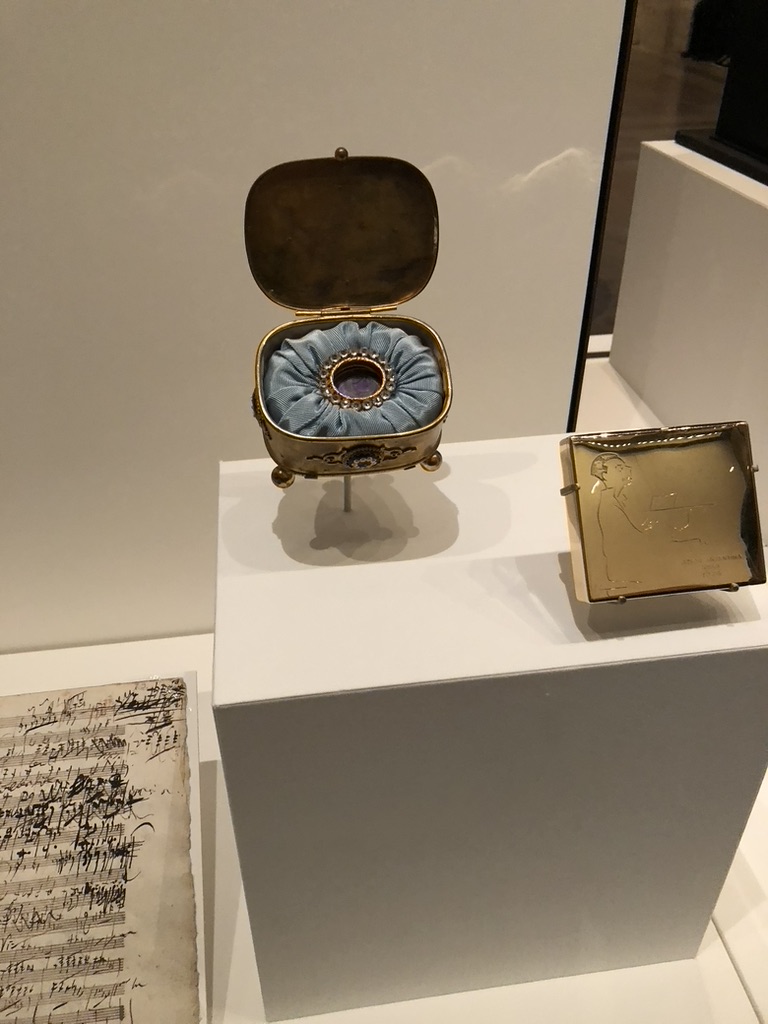
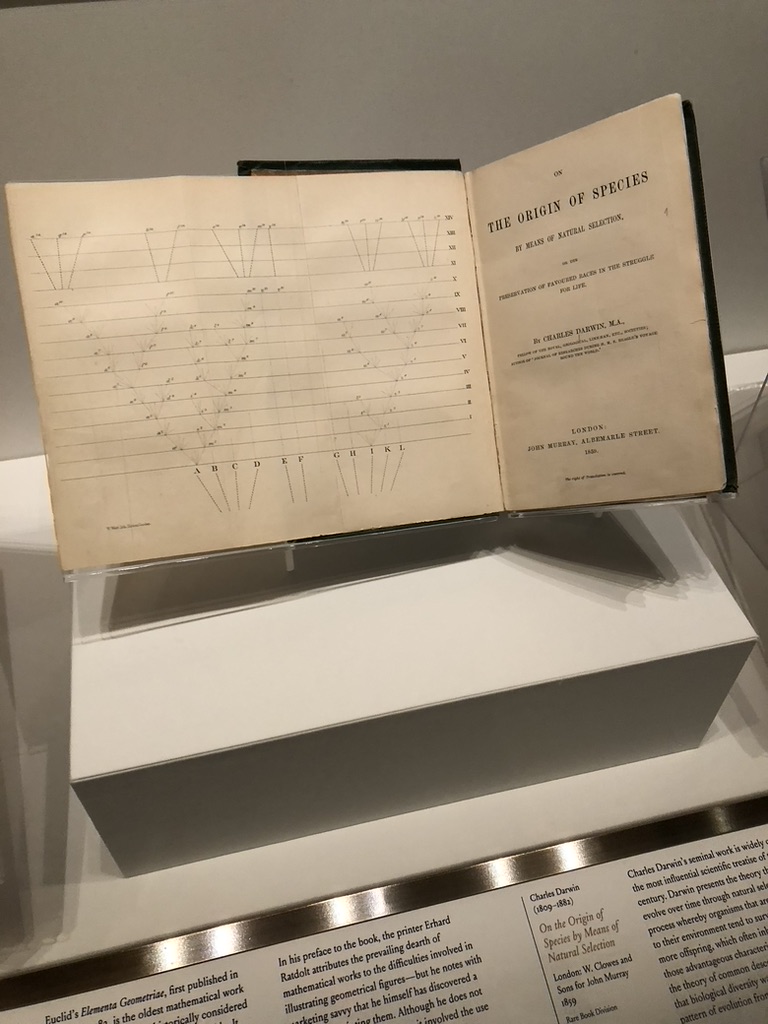
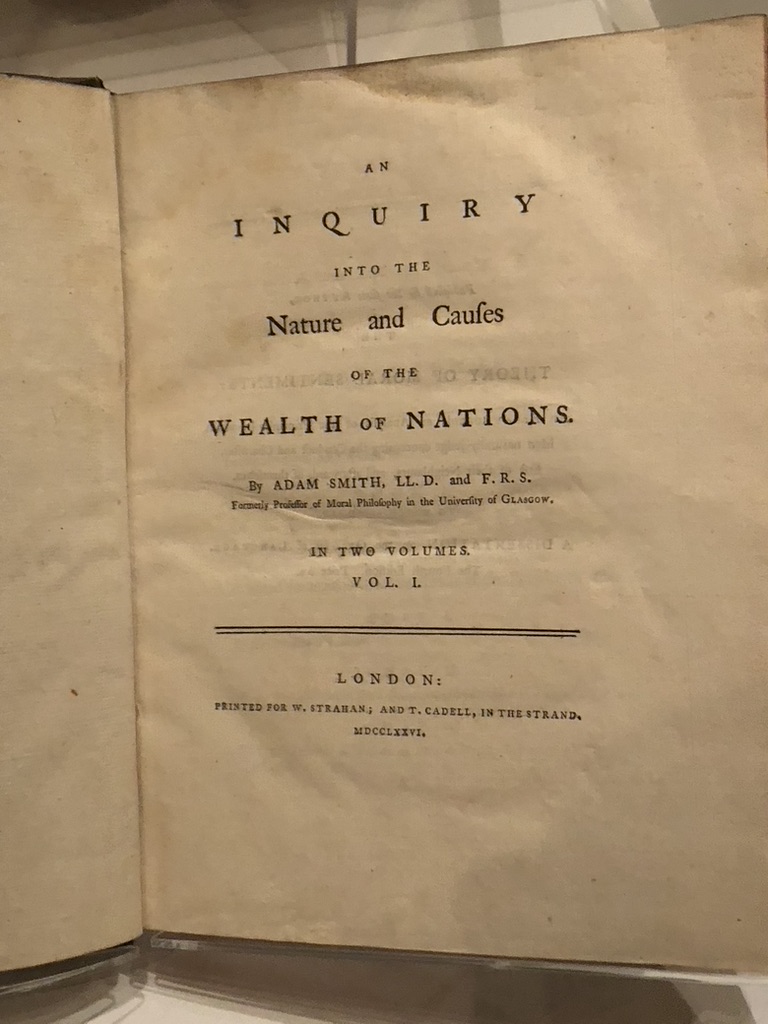
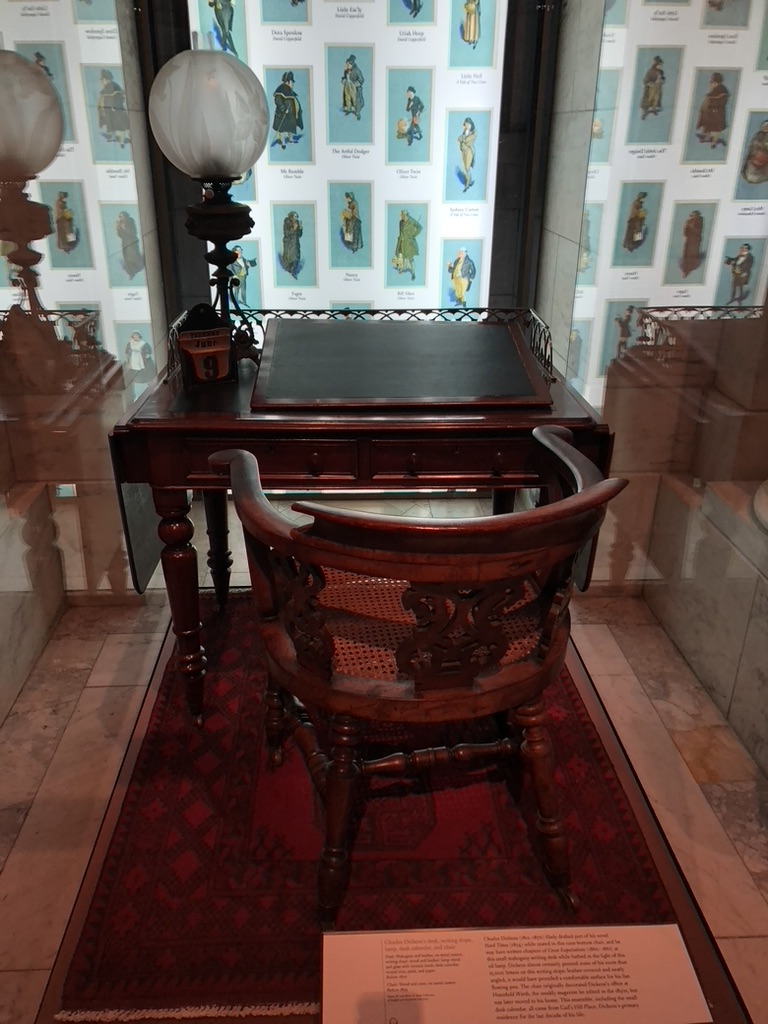
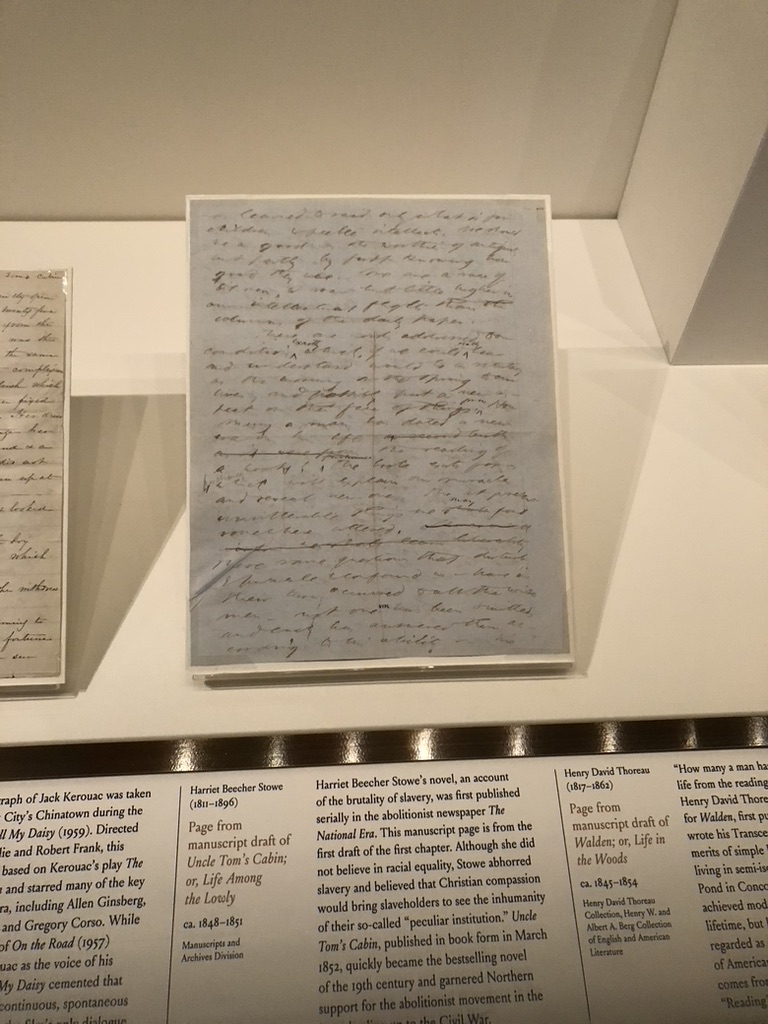
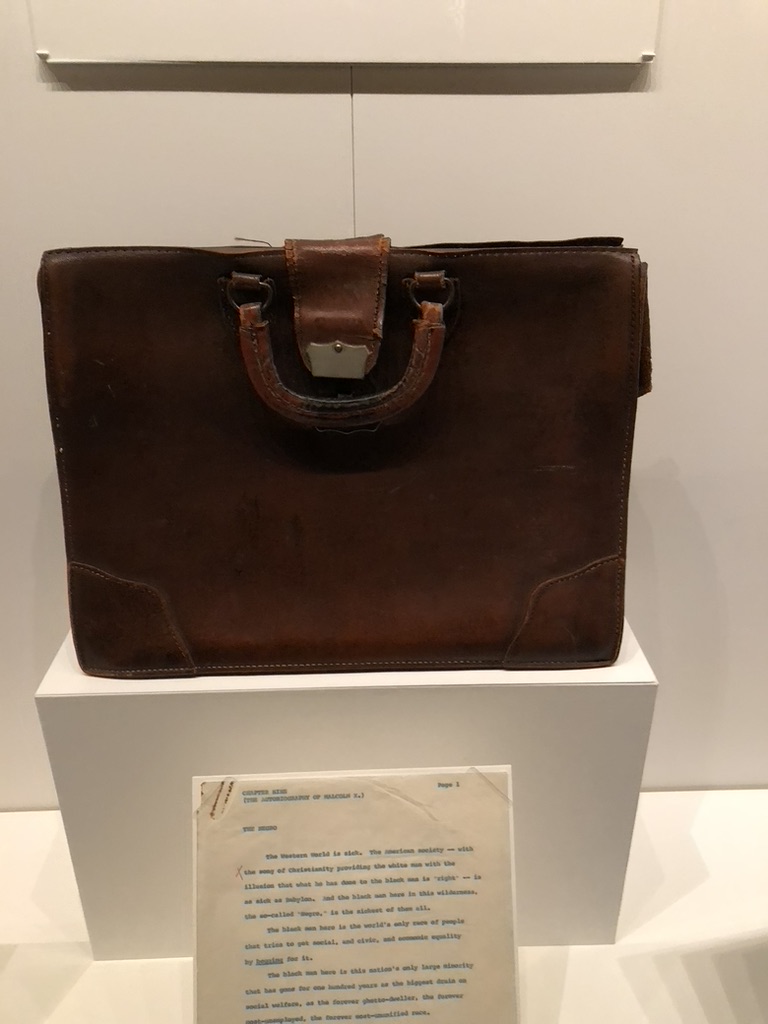
The exhibit arrayed in several rooms was fabulous, that’s all I can say. The exhibition hall is small, but the range of history that is contained in the cases is very extensive. According to a brochure on the exhibit, we learn that this display is divided into nine themes: Beginnings, Performance, Explorations, Fortitude, The Written Word, The Visual World, Childhood, Belief, and New York City. To quote from the brochure, “The collection highlights unique and curious items from the 126-year-old library system’s extensive archives, representing over 4,000 years of human history.”
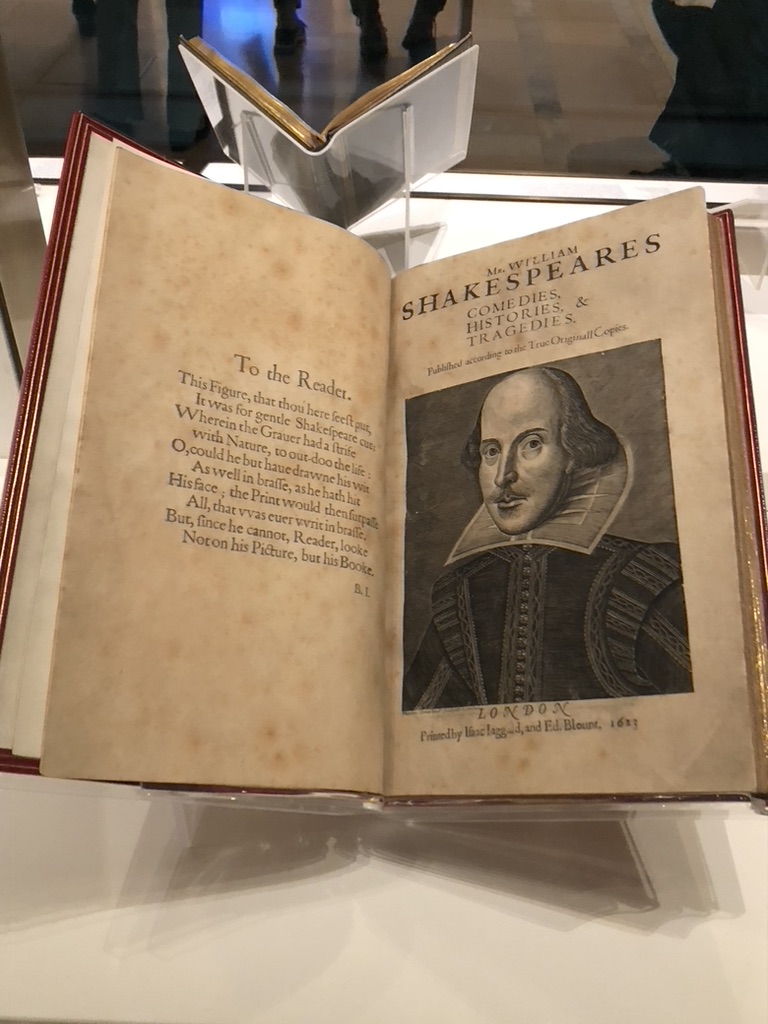
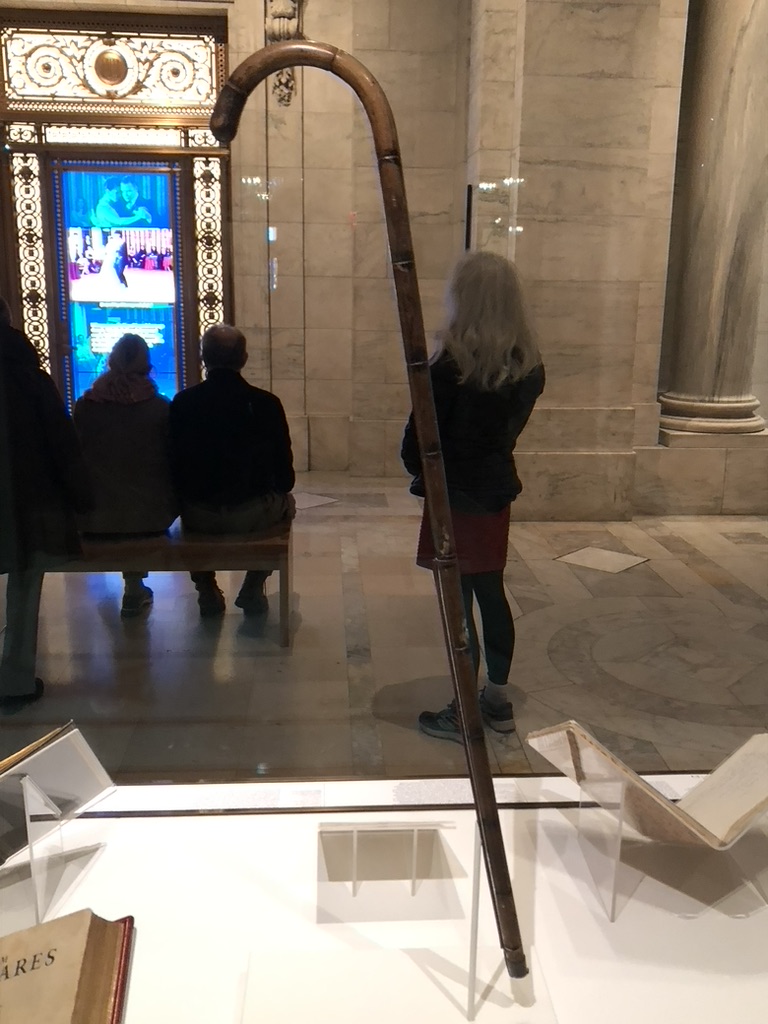
Some of those curious items include a lock of Beethoven’s hair, an umbrella given to P.L. Travers, author of Mary Poppins, the Commisioners’ Plan of 1811, the map that laid out the future development of Manhattan up to 155th Street, and a walking stick used by Virginia Woolf. Other fabulous items included Thomas Jefferson’s handwritten copy of the Declaration of Independence, the Bill of Rights, a first edition of the King James Bible from the early 17th century, a copy of the Koran, a first folio of William Shakespeare’s plays, and early Jewish texts.
In order to see the exhibit, you do have to book your free tickets through the Library’s website, which is what I did. As for when you can see this wonderful exhibition, you don’t have to worry. According to an article about the exhibit that appeared in The City from September 29, 2021, by Aria Velasquez, the time that you have to be amazed is 75 years. Yes, that’s right! The exhibit will run at least 75 years, funded “by a generous gift from philanthropist Dr. Leonard Polonsky,” according to the NYPL. So you don’t have to rush there, but know this, some of the artifacts will be rotated out of the displays after one or two years to make room for more of what the library has to offer. “With over 56 million items in the NYPL’s possession, there is a lot to go through.” With some understatement in that sentence, wouldn’t you say? I do recommend this exhibit wholeheartedly.
After spending close to two hours walking through the exhibit, Elliot and I walked to Grand Central Terminal, where we had a coffee and an almond croissant at the lower level at a Zara’s Bakery. We didn’t see a sitting area where we could have our repast, so we stood by some columns and had our coffee and snack.
We then walked to the subway where we boarded a 6 train to 51st Street where we transferred to an E train. Both cars we entered had several homeless people sprawled across some seats. Thus we nimbly walked around these unfortunate persons and took seats further up in the cars. Will Eric Adams confront this situation with more aggressiveness than his predecessor, I wonder.
The only thing I will say is this: Don’t wait 75 years to see the fantastic exhibit at the New York Public Library! See it within the next two years, possibly.
Stay safe and be well.



 And So It Goes