Today is Saturday, November 5, three days before Election Day. A very frightening online article was written by a former Washington, D.C., police officer, Michael Fanone, who was injured during the January 6 riot at the U.S. Capitol and is becoming a media celebrity, of sorts, on CNN and other outlets for his withering criticism of the Orange Menace and those in his party who have abandoned American principles of fair play and the Constitution as they brazenly seek power for power’s sake. His opinion is entitled “Opinion: American indifference will be the death blow for democracy.” In his analysis, Fanone raises some troubling concerns as to how Americans have reacted to the insurrection fomented by an ex-president last year. He believes that “most Americans just don’t seem to care.” He has reached this conclusion during private conversations with fellow officers who defended the U.S. Capitol on that fateful day.
Another officer confided to Fanone that more Americans might have been more concerned “if a congressman or a senator had been injured, dragged through the halls to the makeshift gallows or killed,” then people might give a damn, according to this former law enforcement official. Fanone then writes that, maybe, if this had happened on January 6, more people would “get it” and “would be motivated to vote on Tuesday as if the future of democracy was on the line.”
Only when Nancy Pelosi’s husband was brutally attacked in his San Francisco home did political candidates, including many Democrats, begin talking about the events of January 6, according to Fanone. Unfortunately, polls show that swing voters care more about gas prices and abortion, according to Fanone. They also show an overwhelming interest in the purported rise in crime, as Fanone indicates.
Fanone cynically doubts that the attack on Paul Pelosi would be a turning point to motivate voters to reject Republicans out of hand, since he believes politically inspired violence is going to escalate, not abate, in this incendiary climate. Very rightly, the opinion writer here believes that this type of violence has been normalized.
In his analysis, Fanone points to the increasing incidents of violence directed toward election workers, elected officials, and even voters themselves as far-right masked zealots guard ballot boxes in states such as Arizona, “not unlike the way the Ku Klux Klan did after the Civil War – for no other reason than to intimidate people of color.” Therefore, the party of Dumpf is using a racist 19th-century playbook to amass power in the 21st century.
It would be fairly reasonable if more moderate Republicans would call out those masked men toting firearms at the ballot box for trying to intimidate lawful citizens from voting, but they do not. The more extreme exemplars of bullying on the repugnican side like Marjorie Taylor Greene, Lauren Boebert, et al. do nothing about this phenomenon other to “revel in throwing gasoline on the fire,” as Fanone states it.
Fanone then describes his amazing transformation from a Trump supporter in 2016 to a never-Trumper voter in 2020 when he realized that he had been duped “by a carnival barker.” He believes then that people can change if he himself was successful at doing so.
The intemperate critic of the former president then states that he believes that the vast majority of Americans who don’t support Dumpf are indifferent to the pain and suffering that the former president has caused so many Americans.
Here he says the “biggest threat to democracy is indifference.” Then he lists reasons why people might be distracted from caring: the purchase of Twitter by a megalomaniac billionaire by the name of Elon Musk, there is the divorce of Tom and Giselle Brady, and the birth of a new Kardashian baby. Personally, I couldn’t care less about these “distractions.” But I’m a little older than most and these stories don’t interest me at all. I’ve never watched The Kardashians and never will!
As Fanone sees it, this coming Tuesday represents “our first chance since January 6 to reject fascism.” He writes, “And perhaps it’s our last chance to preserve democracy.”
He concludes his sobering analysis, saying, “We need to care. We need to vote. And we need to drag our indifferent friends to the polls, before it’s too late.”
We will see next Tuesday if Fanone’s dire predictions don’t come to fruition.
We all need to hear Fanone’s voice here and the concerning words uttered by President Joe Biden about the outcome of the midterms this week should repugnicans prevail.
Today Elliot decided to celebrate my birthday a few days early since my birthday this year coincides with Election Day and is only two days before my upcoming surgery, so we both thought today would be a good day to commemorate it on this warm day in early November.
Thus we left our apartment early before 10:30 to have breakfast in the city and wait on line at TKTS in order to see Tom Stoppard’s new play Leopoldstadt at the Longacre Theatre. This could be considered his last major play since the playwright is now 85 years old and has been writing plays for 55 years. His first play was 1967’s Rosencrantz and Guildenstern Are Dead which was staged by the National Theatre back then. He is the author of Jumpers, Travesties, The Real Thing, Arcadia, The Invention of Love, and other productions. I believe this is my first Stoppard play, regretfully.
Originally, we intended to have breakfast first but once we got to the ticket line at around 11:03 or so and saw the tremendous queue of eager Broadway attendees, we decided to take our place on line. This turned out to be a very wise move on our part since when we finally got to a cashier’s booth after spending more than an hour on line, the ticket agent had only two tickets left to the play, which I thought was quite remarkable. I erroneously believed that audiences would want to see a frothy musical instead of this stark drama about one family’s fate living in Vienna throughout many decades, particularly during the horrors of World War II.
Elliot preferred to have breakfast afterward at Junior’s, on 45th Street, but when we inquired how long a wait it was to sit down, we were told by the hostess that it would be a half hour. We demurred and walked out to patronize the Playwright Celtic Pub, on 8th Avenue, instead.
There we were escorted to a table upstairs and had more of a lunch than breakfast. As long as I had my first cup of coffee, I was fine with this.
I was nervously looking at my watch to see what time it was, but we had enough time to eat our meals and walk to the theater on 48th Street.
We got to the playhouse a little after 1:15 and we walked in with other playgoers. We had to walk up several flights of stairs to the mezzanine and to our seats.
The play follows the fate of two affluent Jewish families connected by marriage. Led by the central character Hermann Merz (David Krumholtz who went to Elliot’s middle school in the 1980s) and his Catholic wife Gretl (Faye Castelow), along with sister Eva (Caissie Levy) and her husband, Ludwig (Brandon Uranowitz), the assimilated clan is seen enjoying the fruits of Viennese culture when we first meet them in 1899. Then events take a dark turn years later in 1938 when the Nazis come to power and the unthinkable happens to the family.
The title of the play is taken from the first Jewish quarter of Vienna. The action of the play concerns what happens to these characters throughout the generations and the onslaught of Nazism in Vienna. “The work explores the long history of anti-Semitism and its impact on middle European Jewry of multiple nations,” so says Chris Jones writing in the Daily News on Monday, October 3.
Other themes that are explored are what identifies one as being Jewish and when is the erasure of one’s identity justified or is it an immoral act, as seen in the character of Leo, who is known by another name, Percy Chamberlain, by a British mother who changes his name and brings him up British in order to spare him the injustices inflicted on the Jewish people. From reading Jones’s review, I discovered that this character resonates personally with Stoppard because his own mother did this in order to have her son survive and thrive without knowing his Jewish identity. Stoppard was born as Tomas Straussler. His mother married an Englishman and that’s how Stoppard was raised.
The one criticism of the work I have is that with the forward motion of the play spanning 56 years, it was difficult to know who was whom. Some characters did not receive much exposition, so it was hard to see who was related to whom. However, I recommend this play to anyone who is interested in rich family drama and the history of Viennese Jewish history during the Second World War. It dovetails very nicely, I think, with Ken Burns’ documentary The United States and the Holocaust, as the state of immigration is discussed in the play as well.
After the play, which ran for two hours and ten minutes, we walked over to 49th Street and Third Avenue, where we had a very lovely dinner at Smith & Wollensky, the famed steakhouse. The dinner was topped off with the waiter and bus boy singing “Happy Birthday” to me over a slice of cheesecake.
Have a nice Sunday. It’s supposed to be as warm as it was today. The temperature is supposed to be 72 tomorrow.
Oh, and don’t forget to move your clocks back this morning.
Stay safe and be well.
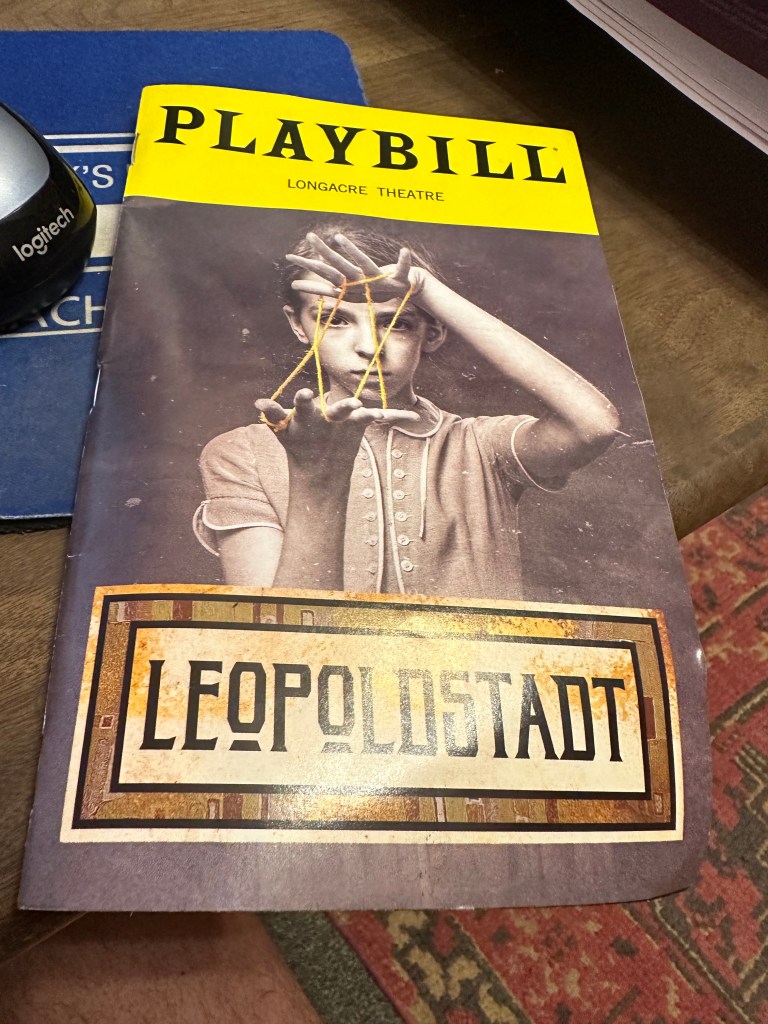
Here is the Playbill from today’s Tom Stoppard play.
 And So It Goes