Today is Friday, March 24, 2023. As I try vainly to adjust being back in the United States, with its relentless coverage concerning a former president who is now showing his extreme psychopathic frame of mind by lashing out at the New York prosecutor, Alvin Bragg, who will most probably indict him for the same reason that his former hangdog counselor Michael Cohen was sent to prison for three years, and seeing braindead Marjorie Taylor Greene leading a delegation of MAGA repugnicans to a Washington jail to meet with January 6 insurrectionists to see how they were being treated in prison, I realize how I miss France, even with its innumerable strikes and protest marches. I really enjoyed not hearing American news on our French channels in both Paris and Nice for over two weeks, but now that I’m home, it’s back to CNN or to MSNBC, as usual. Maybe I should now watch more intermittently than as frequently as I would normally do. My blood pressure would moderate as a result, I would dare say.
Talking about France then, I came across a very intriguing online opinion by Catherine Poisson who writes as a native of France but who has lived in America for many years and offers her opinion that “work” means something vastly different in her native country than here in the United States. Her piece is called “Opinion: ‘work’ means something different in France than in the US.” Poisson, by the way, is an associate professor of Romance Languages at Wesleyan University in Middletown, Connecticut.
I would like then to lead with this piece that explains the experience of work for Parisians as opposed to how Americans view the experience. She begins her analysis by saying that Americans are mostly puzzled by the recent protests over retirement benefits that are roiling her country of birth.
For the past three months, France has been gripped by a “spasm of demonstrations” over moves by the government to raise the retirement age from 62 to 64. President Emmanuel Macron just narrowly survived a no-confidence vote in the French Parliament. A new round of mass protests called by organized labor took place yesterday – the ninth day of strikes since the bill was introduced in January. (That is why we are so lucky that we didn’t stay an extra day in France and came home on Wednesday.)
Schools are closed because teachers are on strike. (No wonder I saw so many children out on the streets during the time I was in Paris and Nice.) Poisson does point out that Paris’s city streets have been strewn with tons of trash after sanitation workers launched a labor action in solidarity.
Poisson’s point is that the kind of upheaval in her country “would be almost unthinkable in America.” She further states, “Americans seem not to be able to understand the source of the boiling rage felt by the French over the planned increase in the retirement age.”
The closest analogy in the United States, Poisson indicates, would be the decision four decades ago to raise the age at which Social Security benefits are doled out. Exactly four decades ago then, in 1983, full Social Security retirement benefits were raised from 65 to 67 over a 22-year period, beginning in 2000. Older Americans do feel strongly about Social Security and often cast their votes accordingly, according to Poisson.
The situation in France is elaborated on by Poisson in that French citizens have a generous health care system, not seen in the United States, which means workers pay next-to-nothing out of pocket for medical care. University education is nearly free in France – while it is definitely not here. Unemployment benefits are sustainable enough to allow laid-off workers to maintain a reasonable quality of life while they look for their next jobs.
Now Poisson elaborates on the difference of being a worker for both countries and why it’s so different in France as opposed to the United States. Thus in our country, “work is an identity,” whereas in France, work just refers to a finite period lasting roughly 40 years, and when that work is done, “you are still young enough and fit enough to enjoy the best of what life has to offer.” It’s these years that the French spend traveling, caring for grandchildren, or picking up new hobbies.
Therefore, French workers do work hard during their most productive years and fervently look forward to the “Troisieme Age” – the “third age.” This period corresponds to retirement age and the decades following it if one enjoys relatively good health during that time. This third age, according to Poisson, promises a good, healthy retirement free from want and worry – which is the kind of retirement many in this country cannot even dream of. The writer then contends, “It is no wonder that people are willing to take to the streets to protect it.”
Another reason for the ongoing protests is pushback against Macron’s impervious governing style, in that his critics see him acting more like a sovereign rather than as an elected official. Poisson says that years ago, Macron earned the nickname of “Jupiter,” after the king of the Roman gods.
The not-so-well-liked President says that retirement reform is necessary because the system is near collapse, but Poisson says that there is some disagreement about that, however. She feels that the budget appears to be balanced for the next dozen years, although it’s true that falling birth rates and increasing longevity pose a problem that will have to be addressed.
Some moves Macron could implement is reversing his move to abolish the wealth tax and even reconsidering corporate tax breaks that have benefited big business handsomely.
Last week, Macron’s imperial style was clearly in evidence when his administration used a constitutional maneuver to bypass a vote in the National Assembly and raised the retirement age without full consent, which incensed French workers even more. (I saw this happen on French news last week.)
Anyway, all of this shows that the unions are not backing down anytime soon and are continuing to organize massive protests urging workers to stand firm and remain off the job, which seems quite alien in this country. I wouldn’t hesitate to say that the French pastime is striking. So I hope this analysis helped you to understand why the French are so passionate about this issue and why they took to the streets to demonstrate against the amended change.
Now back to our reigning psychopath, Donald J. Dumpf, who today warned of “death of destruction” if he is indicted for paying hush money to porn star Stormy Daniels, which he vehemently denies. This rhetorical call to violence was covered in an online article for the Daily News by Michael McCauliff and Dave Goldiner entitled “Trump warns of ‘death and destruction’ if he’s indicted in NY case.”
Responding like someone who really does see a prison cell in his future, Dumpf suggested today that his supporters will respond with fury if he is criminally charged in the case as early as next week when a grand jury reconvenes to deliberate.
The former twice-impeached president lashed out at the prosecutor, Alvin Bragg, who is Black, calling him an “animal” and falsely accusing him of being manipulated by George Soros, the liberal Jewish mega donor who has funded campaigns of progressive district attorneys like Bragg. Thus in one putrid tweet, the ex-president dragged out both the race and anti-Semitic card. In response to Dumpf’s reprehensible comments, Rep. Hakeem Jeffries, the House Democratic leader, said that “(Trump)’s rhetoric is reckless, reprehensible, and irresponsible. It’s dangerous. And if he keeps it up, he’s going to get someone killed.”
Bragg is investigating whether Dumpf broke the law in paying Daniels $130,000 to keep her from talking in the days leading up to the 2016 presidential election about a previous sexual encounter she claims they had.
Today Evan Corcoran, Dumpf’s primary defense attorney, appeared before a federal grand jury in Washington, where he was expected to answer questions in the classified documents probe that the former president unsuccessfully fought to contain. This is another case embroiling Dumpf in more legal jeopardy and now it appears that Dumpf’s minions are being forced to offer testimony before grand juries investigating him.
The New York panel is expected to meet again on Monday when it may be asked to consider indicting the childish insulter. The charges could include falsifying business records to cover up the payments, which would be a misdemeanor. Dumpf could also face felony charges if prosecutors can show the bogus records were created to commit or cover up some other crime, possibly campaign finance, obstruction of justice, or tax laws.
Even though he wasn’t indicted on Tuesday, it now looks as if the competing investigations are all approaching some sort of fever pitch, with some resolution hopefully in sight. The only resolution I, and millions of other Americans, finally hope for, would be that little indictment.
I’m now reading other media sources that claim that Dumpf is definitely out of his mind for posting such garbage on his “Truth” Social account. Most critics contend that Dumpf is obviously very nervous and is just lashing out. MSNBC host Al Sharpton puts it aptly this way, “He (Dumpf) is hearing footsteps and they’re getting closer.” Morning Joe host Joe Scarborough said, “The guy is shaking in his boots.”
Let’s see then if those footsteps do get louder sometime next week. The country can’t face more of Dumpf’s brutal rhetoric and calls for violence from his red hat supporters. Enough already!
I forgot to mention that “wacky” Dumpf is having a rally in Waco, Texas, tomorrow, which I hope will be a true disaster for this pudgy son of a bitch. The timing couldn’t have been more significant since it coincides with the 30th anniversary of the Waco siege that ended with the deaths of 86 people, including dozens of children. The site holds symbolic significance for loony far-right groups that revere the location as some sacrifice to the cause of antigovernment martyrdom. I truly hope no one comes to the buffoon’s rally, but we shall see.
Have a good weekend.
Stay safe and be well.

Here are people demonstrating in the street on March 14, I believe.

Here is the same demonstration.
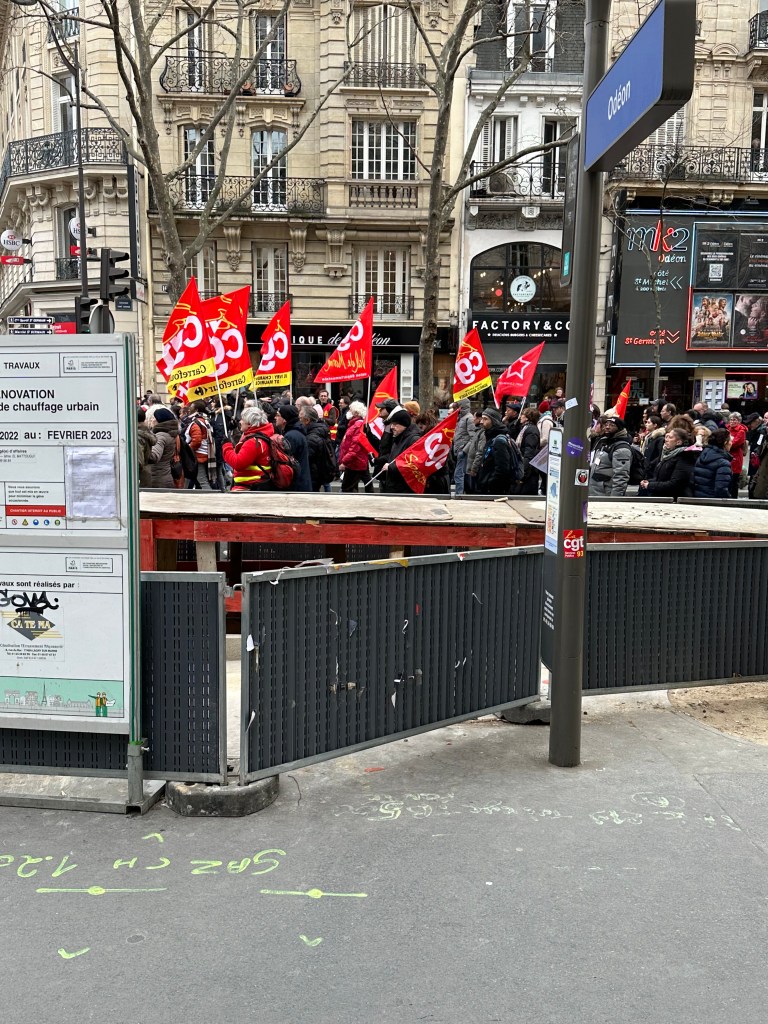
This is the CGT (General Confederation of Labour), a national trade union, that is demonstrating in the street. This was founded in the city of Limoges in 1895. It is the first of the five major French confederations of trade unions.
 And So It Goes