Today is November 9, 2023. Today marks the 85th anniversary of Germany’s Kristallnacht – or the “Night of Broken Glass” – in 1938 in which the Nazis terrorized Jews throughout Germany and Austria. For this solemn occasion, Germans came together across the country, in schools, city halls, synagogues and churches, and parliament to commemorate the day of organized madness. This event takes on a significant poignancy today as Jews across the world are seeing exponential rises of antisemitism arising from the Israeli- Palestinian conflict that began on October 7. An online article for algemeiner posts a haunting question after the terrorist group Hamas brutally murdered more than 1,400 innocent Israelis and kidnapped another 240 blameless human beings and it’s written by Meryl Ain.
It is Ain’s contention that the media is only now focusing on what’s happening in Gaza, despite the fact that women were raped, families were executed, children were burned, and elderly and disabled people were massacred, ignoring that if Hamas had the chance, they would commit those atrocities over and over again, and ignoring that Israel is still under attack from Hamas rockets and threats and assaults from its neighbors.
As a result of the horror that occurred on October 7, the Anti-Defamation League (ADL) says that antisemitic incidents are up 400 percent and we see college students supporting the Hamas massacre and sharing incorrect information they’ve seen on social media. “For Jews throughout the world, the Hamas attack evokes the Holocaust.”
Kristallnacht was a wave of coordinated antisemetic violence that took place in Nazi Germany and Austria on November 9, 1938, more than a year before the onset of war. Hundreds of synagogues were set on fire and Jewish cemeteries were desecrated. The windows of Jewish-owned stores were smashed and desecrated with swastikas and anti-Jewish slogans. The Nazis broke into Jewish homes and terrorized those living there. Rioters attacked and killed Jews on the street.
The only antidote to the explosion of antisemitism arising from the conflict that Israel was thrust into in early October, according to Ain, is a global response from everyone in the free world, since there aren’t enough Jews in America, Israel, or throughout the world to fight this war alone. Let’s see if this kind of response is actually offered then.
For my birthday yesterday, Elliot and I were treated to a fairly new play on Broadway called Harmony which was written by pop star Barry Manilow and Bruce Sussman. The tickets were bought for us by Elliot’s cousin in Scottsdale, “Joan.” We were very eager to see this new play that centers on the real-life exploits and tragedy of a vocal sextet called the Comedian Harmonists who were huge in Germany in the 20s and early 30s until the Nazis came to power and shut them down. I can’t stress enough how relevant this play is in today’s charged environment.
With this melange of low comedy and gripping drama, the audience is presented with the formation of this band in 1927 by Harry Frommermann, an unemployed actor, who placed an ad in the local paper seeking singers. What he got were a former rabbi from Poland, Roman Cykowski; a Bulgarian singing waiter, Ari Leschnikoff; an operatic bass, Robert Biberti; a young medical student, Erich Collin; and a skilled pianist, Irwin Bootz. What this eclectic group did more than sing close-harmony versions of American jazz standards, German folk songs, and novelty numbers, they also included deft musical and physical comedy in their act – hence the qualifier “Comedian.” A very funny number from the play is the musical number, “How Can I Serve You, Madame?” that is sung in boxer shorts at the Barbarina Club, in January 1930.
The diverse group included three Jews and three Gentiles. Bruce Sussman says at one point about the group’s diversity, “This group represented the very diversity that the German nation at this point was saying was toxic. Not only were there Jews and Gentiles in the group; there was a Bulgarian, an Italian, a Pole; they were from all strata of class. The definition of harmony, the nonmusical definition, from the Greek, is diverse elements brought together in a unified synthesis. They were the embodiment of that.”
As for the critical element of the play, Elliot was not blown over by the production as I was more enamored of the production values of the play. However, I was not altogether uncritical of some elements of the play. I thought there was no semblance of a German accent in any of the actors who were portraying Germans on stage. Even though there were six members of this very talented sextet, there was more critical focus on just two of the principals, the man called “Rabbi” who is portrayed as the only survivor, at 87, by Chip Zien, and as a younger man by Danny Kornfeld and the virtuoso piano player who is nicknamed “Chopin” and is played by Blake Roman.
In the role of the narrator, Zien shines as the wiser veteran of the group who wishes the group had decided to stay in America in 1933 where they were performing at Carnegie Hall to enthusiastic fans. Instead, the group decided to return to Germany where they were to meet with expected tragedy because of the ethnic composition of the sextet. Eventually, the Third Reich soon banned the sextet from singing pieces by Jewish composers, then burned their existing films and recordings, and ultimately prohibited the group from performing to the public until its Jewish members were summarily dismissed. One line by Zien that got a round of applause is when he says at one point, “Dictators never change, even when their rants do. It’s the same hate, just different uniforms.”
Another criticism of the show is the female leads, Mary (Sierra Boggess) who marries Rabbi and Ruth (Jessie Davidson) who is Jewish and marries Chopin. Mary is not Jewish but loves her Jewish husband and Ruth is Jewish and is married to the non-Jewish Chopin, and is seen in early scenes staging protests in the street against the coming of the Nazi regime. She upbraids her husband all the time to stand up to the Nazis. These two women do not do much else in the play except sing a heartfelt duet called “Where You Go” in Act II.
Even though the play doesn’t succeed on all levels, in my humble opinion, it’s significant that Manilow and Sussman have here given voice to this long-vanished troupe that deserves the attention of a modern audience.
Stay safe and be well.
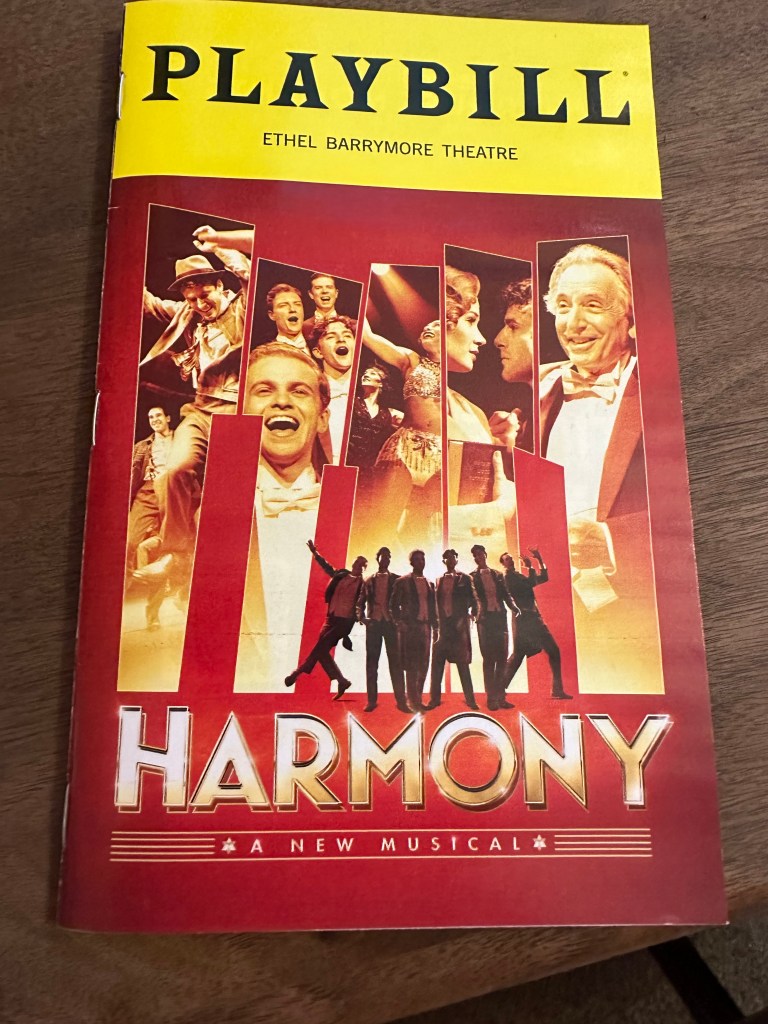
Here is the playbill from Harmony at a time when there is little harmony in this country and in the world, sadly.
 And So It Goes