Today is Sunday, March 17, 2024. Today was a glorious St. Patrick’s Day and Elliot and I took advantage of the 60-degree weather to drive to Williamsburg, Brooklyn, to have brunch at a new restaurant called Cafe Colette, located on Berry Street. We enjoyed various brunch menu delicacies like strata for Elliot that was composed of sourdough, eggs, caramelized onion, spinach, gruyere, and parmesan served with salad and I had the French toast that consisted of brioche, cinnamon, and maple syrup. We also started with a house-made scone that tasted more like a flourless chocolate cake than a scone. Even the coffee was quite robust. Also, Elliot engaged our server, Daniel, in a long-range conversation about New York and music. Daniel admitted to us that he moved to New York from Vermont and has been in the city about 20 years.
From Cafe Colette, I made my way to Bedford Avenue where I browsed my usual bookstores (Elliot and decided to walk to McCarren Park where I was supposed to meet him in an hour), but this time I dropped into the Apple Store to research buying a new automobile charger. It seems that my old charger was working intermittently – or not at all – with my smartphone, where it signaled time to purchase a new one. So I walked in and spoke to the assistant at the front of the store and asked where I could get a new car charger. He mentioned that I needed to go to the back of the store and to the left. Which I did! I found a young sales assistant to work with me and she directed me to the right hardware on the left wall. I had to buy the USB car charger and cable separately which cost over $40.
From Apple, I made my way to Book Thug Nation, on North 3rd Street. I scanned the book shelves outside and I found a worthwhile book by the late author William Styron, Havanas in Camelot, which consisted of a series of personal essays that were previously unpublished before the author’s death. This collection cost me a remarkable $1.
I did meet Elliot within an hour at the park and I called him when I got to the entrance on Bedford Avenue. He informed me as to where he was sitting and I managed to find him without too much ado. We didn’t sit all that much since Elliot said he was getting a little chilled, so we got up to walk back to the car.
Before getting into our car and driving home, we darted into Qahwah House, characterized as Williamsburg’s first Yemeni coffee shop, on Bedford Avenue. Inside, there were many patrons sitting having their coffee or tea. I learned that Yemeni coffee beans are famous for their complex flavor profiles. In general, Yemeni coffee is earthy, rich, and bold which is what I found with the small coffee I had. Elliot eschewed coffee for hot chocolate and I thought the beverage was very good since I had a little sip of his hot chocolate.
In honor of St. Patrick’s Day, I want to provide a pronunciation guide that I found online at CNN that might help you with difficult Irish pronunciation. I know I certainly needed this guide because of my lack of understanding of nuances of the “Gaelic” (that’s a faux pas, as I will explain at the end of this synopsis) language.
The article is written by Maureen O’Hare and it’s entitled “Irish names you’re probably saying wrong and how to pronounce them.”
To begin with, we have the name of the most recent Academy Award winner, Cillian Murphy, who won the best actor award in the title role of the anguished “father of the atomic bomb,” J. Robert Oppenheimer. The author of this article called on the help of Irish language and culture expert Darach O’ Se’aghdha. Don’t ask me how to pronounce this expert’s name!
So first rule: when you see an Irish name beginning with C, it’s always a hard C. Therefore, Cillian is pronounced “Kill-ee-an.” According to O’ Se’aghdha, the Germanized version of Killian used to be the dominant spelling in Ireland, but in 2003, the C spelling took over and has reigned supreme ever since. That year, by the way, marked Murphy’s breakthrough role in 28 Days Later, a very popular zombie horror movie.
That same C rule applies to boys’ names Cian (Kee-an), Ciaran (Keer-awn) and for the girl’s name Ciara (Keer-ah).
Now we go to Irish actress Saoirse Ronan. Do you know how to pronounce her first name? Me neither. Her first name then is pronounced as “Sor-sha.” Her name actually means “freedom,” which first became popular in the newly independent Ireland of the 1920s and has most commonly been pronounced “Sorsha” or “Seersha.”
Irish names also might have an acute accent over letters, usually an O, slanting to the right. This is called a “fada”; when it’s above a vowel, it means the vowel should be pronounced “long” – which is what fada means in Irish.
Fadas are often dropped in English, but in Irish pronunciation they are crucial. Take the first name of Irish-American talk show host Cona’n O’Brian. When anglicized it’s “Co-nin,” but with native pronunciation Conan is “Co-Nawn.” Likewise with Ronan (Ro-nin) and Ronan (Ro-Nawn), which, incidentally, means “baby seal.”
Another popular girl’s name is Siobha’n as in Siobhan McKenna who was an Irish stage and screen actress who died in 1986. This name is pronounced as “Shiv-awn.”
The name “Sean” has a fada when written in Irish – Sea’n (Shawn) – which is why the endings of Sea’n and Siobha’n rhyme with “lawn” and not “can.” Another example is Aisling – meaning “dream” – which is pronounced “Ashling” (and sometimes spelled that way).
The girl’s name “Maeve” rhymes with “wave.”
The masculine name Tadhgh is pronounced as “tige.” This name was once so ubiquitous that it became an ethnic slur for Irish people, in the same manner as “Paddy” or “Mick.”
Here the “g” is clearly heard in “Tadhgh,” but depending on the consonants around it, the “g” in “gh” might not be heard at all. Take “Bronagh” (Bro-nah”) or Oonagh (anglicized as “Una”), for example.
Another Irish actor making waves in Hollywood at the moment is Saltburn star Barry Keoghan, where his name is pronounced as “Barry Kyo-Gann” with a hard “g.” Typically, this name would sound more like “Kyo-ann.”
Another popular girl’s name is Fiadh. The “d” here is not pronounced. Her name is now sounded as (Fee-ah) and is perhaps the biggest Irish name of the 21st century, according to O’ Se’aghdha, the Irish language expert. It was the second most popular girl’s name in Ireland in 2023, after Grace. Fiadh means “grace and wildness.”
One tongue-tying name is Caoilfhionn. How would you tackle this name? Very gingerly, I would say. But the pronunciation is simply “Keel-an.”
One last boy’s name is Pa’draig. This is the Irish version of the anglicized name “Patrick,” and it’s pronounced as “Paw-rig” or “Pawd-rig.”
So if you’ve been wondering how that Irish expert’s name is pronounced after all of this is Da-rach (rhymes with “Bach”) O’ Se’aghdha (O Shay).
Now do you get Irish pronunciation a little bit? I hope you do. Oh, and now I should mention that the name for the Irish language is “Irish” or – in the language itself – “gaelige” (the pronunciation varies by dialect). Don’t call it “Gaelic,” which I just did much earlier on this page.
So if you wanted to say “Happy St. Patrick’s Day” in the vernacular, you would say “sa’sta st. Pha’draig.” Isn’t that a mouthful?
Have a good week.
Stay safe and be well.
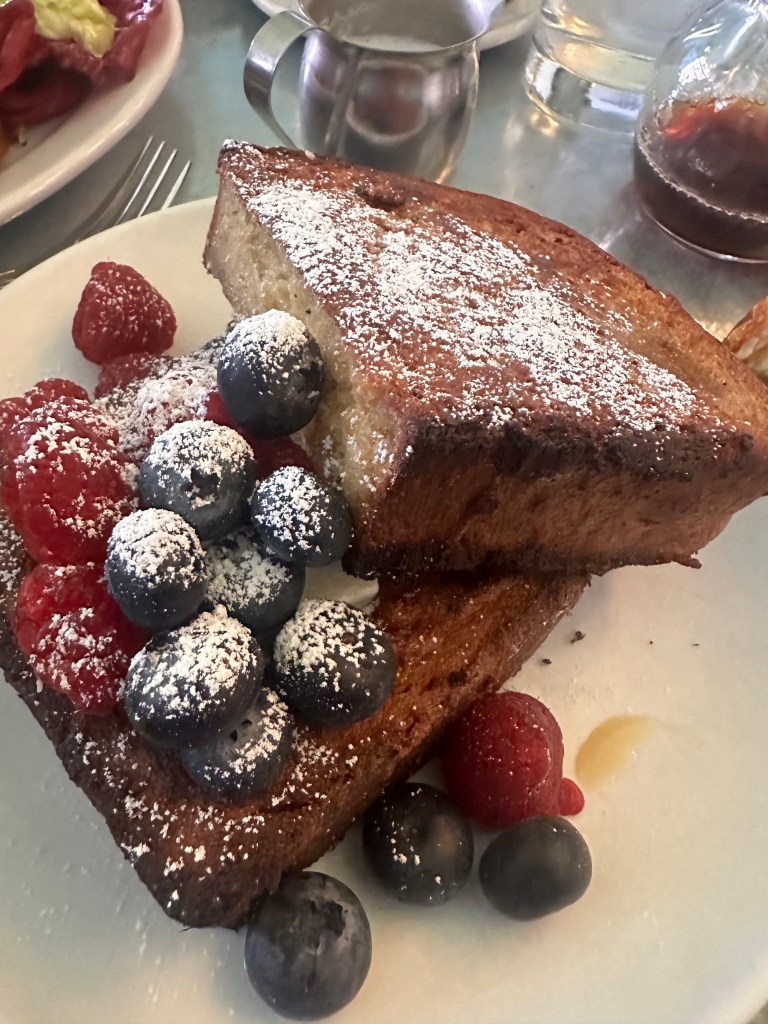
This is my French toast at Cafe Colette, in Williamsburg, Brooklyn. I couldn’t finish it, naturally.
 And So It Goes