Today is May 16, 2024. The day is coming to a close very fast, as I was surprisingly out reveling in Broadway’s new musical on the early suffragist (not “suffragette,” as explained by the pioneering members of the movement to the audience) in Shaina Taub’s play Suffs, apparently produced by Hillary Clinton. I received my complimentary ticket to this new play by my friend “Seth,” who texted me just two days ago that he accidentally bought the ticket and couldn’t go. I wasn’t sure I would go at first, but I relented and finally assented to going. Hell, who would turn down a free ticket to a Broadway show – unless one was otherwise engaged, and I wasn’t this evening, since I was just out with Elliot last night having dinner with my Manhattan cousins at the Italian restaurant 83 1/2. That dinner lasted close to three hours, where we returned home after 10:30 p.m.
The play, which opened sometime in April at the Music Box Theatre, is about the fight for women’s suffrage as seen through the eyes of one of the main activists of the cause, Alice Paul, here essayed by the playwright herself (she also wrote the book, music, and lyrics) Shaina Taub. She’s already been compared to Lin Manuel Miranda, the genius behind Hamilton several years back.
Here the play concerns itself with Paul being pitted against other suffragists like Carrie chapman Catt (Jenn Collela), Black feminists like Ida B. Wells (Nikki M. James), and workers’ firebrands like Ruza Wenclawska ((Kim Blanck). Each had demanded a piece of the movement’s agenda, as so vividly outlined in the various scenes of infighting and the catchy, witty songs.
The two-and-a-half hour show opens up with the older activist, Catt, singing “Let Mother Vote,” which introduces her more nonconfrontational style as opposed to the younger Paul who wants to demonstrate in front of the White House and its then-occupant, Woodrow Wilson.
We are soon introduced to Paul’s inner circle of women suffragists: Doris Stevens (Nadia Dandashi), her college friend and fellow firebrand, Lucy Burns (Ally Bonino), the lawyer Inex Milholland (Hannah Cruz), and the aforementioned Wenclawska. One particularly memorable song from Act 1 is “G.A.B.” which stands for the Great American Bitch. Four of the women sing this rollicking number in defiance of the epithet that men throw at them for their allegiance to the cause. A very amusing aside from the song is Burns’ refusal to say the word “bitch,” so she sidesteps it at every turn she gets.
What is intriguing about the casting is that all of the roles are played by women, even President Woodrow Wilson, here played by Grace McLean, and his chief of staff, Dudley Malone (Tsilala Brock), who is drawn to one of the suffragists, Doris Stevens, and eventually becomes a supporter of the women’s cause, where he sings his resignation letter from the White House in Act 2, in “Respectfully Yours, Dudley Malone.” Malone and Stevens sing a charming first-act ditty called “If We Were Married,” and the song becomes a quartet in Act 2 when Catt and her longterm companion Molly Hay (Jaycee Macapugay) sing it. However, their “If” holds no hope since it’s still the early years of the 1900s when marriage equality was not even a whisper in the land. How sad!
What little criticism I had of the play was the characterization of Wilson who is shown here as a cartoon fop, almost too silly to take seriously. He is portrayed throughout as unenlightened and a bit of a misogynist who actually believed that women should be treated as inferiors; just keep them in the kitchen and baking bread, that sort of thing. Of course, most men thought this way way back in 1913 anyway. It was the Women’s National Party that had to disabuse them of their Neanderthal thinking.
Anyway, there are some mighty fine performances in Suffs, especially by Taub in the title role, Colella as Catt, the older feminist and head of the first national association of women devoted to getting the right to vote enacted by Congress, Nikki M. James as the fiery Ida Wells who sings a defiant first act denunciation against Paul’s hesitancy to treat Black women as equals in the suffrage movement called “Wait My Turn.”
The performance I saw was characterized by great enthusiasm by the audience, which I gathered had seen the show already. They hooted and hollered as soon as the cast came onstage. But the opprobrium was well deserved and some of the numbers brought tears to my eyes as the struggle to adopt the right to vote took many, many years to achieve. The 19th Amendment, adopted in 1920, gave women the right to vote. And it was achieved through much blood and guts, as this play so brilliantly captures.
Run, don’t walk to the Music Box Theatre to catch this very topical show. It will make you want to march for women’s rights all over again! Which is what women are doing since the GOP attack on women’s rights enshrined in the 2022 overturning of Roe v. Wade and the subsequent whittling away of women’s reproductive rights thereafter. It’s never too early or too late to march for a cause you believe supremely in, as the play signals. No wonder the audience howled with approval during every song and plot turn in the long march to fairness depicted in the production.
Stay safe and be well.
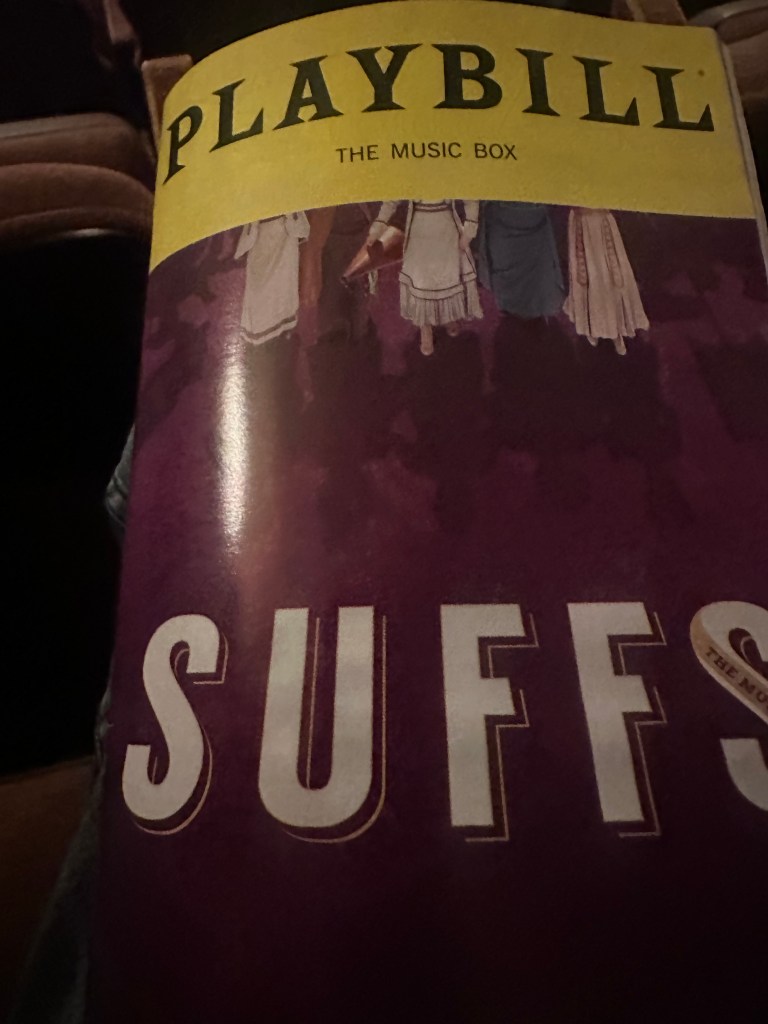
Here is the playbill from the show.
 And So It Goes