Today is Sunday, June 30, 2024. Finally, for those who of us who have waited all these months for a decision by the rogue “Extreme” Court on Dump’s ridiculous claims of presidential immunity, tomorrow the nation will hear the court’s decision regarding Dump’s claims of executive immunity from prosecution. Here the court dragged its robes in determining a ruling on the matter since it first heard oral arguments for and against as early as April 25. It is now July 1. Today an online CNN article by John Fritze entitled “How the Supreme Court could decide Trump’s blockbuster fight for immunity” details how the court could decide on this critical issue.
If you’ve been following the case, an appeals court ruling earlier this year found that Drumpf was not entitled to any protection at all, but the matter went to the Supreme Court anyway in April because Dump’s legal team filed an appeal to it. At issue here is special counsel Jack Smith’s prosecution of Trump’s effort to overturn the 2020 election, including with his actions on January 6, 2021, in which the court’s decision could have implications for other criminal cases against the former liar-in-chief as well.
Speaking about how Dump has already won here, Jonathan Entin, a professor at Case Western Reserve University’s School of Law, said, “Trump has already won something. As a practical matter, Trump has gained time here, regardless of how the court decides the case.”
Here’s a look at some possible outcomes and what those decisions could mean for the timing of a trial, which seems more remote as time wears on.
Trump’s out of luck: No immunity
The simplest outcome would be for the Supreme Court to rule that former presidents are not entitled to immunity from criminal prosecution. That was the conclusion the U.S. Court of Appeals for the D.C. Court reached in February in a unanimous opinion. That ruling could allow Dump’s trial to get under way almost immediately.
However, this does not seem the approach that the court might rule since if it agreed with this reasoning, it probably wouldn’t have taken up Drumpf’s appeal in the first place. During oral arguments presented on April 25, several of the court’s centrist conservatives – who else? – notably chief Justice John Roberts and Justice Brett Kavanaugh – made clear that they didn’t agree with the appeals court’s approach.
Nixon and the ‘outer perimeter’ of power
“But the justices could reach more broadly by granting some degree of immunity for ‘official’ actions.” Based on the oral arguments, it appeared there was support for doing so.
That outcome would raise a number of substantial questions, including what counts as an “official” action. Dump based most of his argument on a 1982 decision called Nixon v. Fitzgerald in which the Supreme Court ruled that presidents enjoy “absolute immunity” from civil lawsuits for official actions to the “outer perimeter” of their duties.
The case involved a former Air Force employee, A. Ernest Fitzgerald, who was fired after he provided damaging testimony to Congress about production problems with the C-5A transport plane. Fitzgerald tried to sue former President Richard Nixon for damages.
What I see problematic with this reasoning from Dump’s legal team is that this case applied to civil lawsuits filed against a president, not criminal prosecutions, which is what Smith’s case entails. However, Dump is now arguing that the Fitzgerald case should apply to criminal prosecutions of former presidents as well. Nah! No way, but this court has acted unpredictably in the last few years, and tomorrow’s decision is no different.
How Trump can ‘lose by winning’
No matter what the majority of the Supreme Court decides about immunity for official conduct, at least a portion of the charges against Dump could proceed if some of his actions were private – that is, steps he took as a candidate or private citizen rather than as a president.
Even Dump’s lawyer conceded during the argument that many of the actions his client took were private, such as asking his attack dog Rudy “Ghoul”iani to spread false election fraud claims. So there we are! If the court now makes clear that Drumpf’s actions were private and not covered by any official act immunity, that could speed the path to a trial. Yippee!
Matthew Seligman, an attorney and a fellow at the Constitutional Law Center at Stanford Law School, said, “Trump can win by losing by running out the clock.” He also added, “But he can also lose by winning, because even if the court adopts his rule, he still goes to trial because a critical set of his conduct is indisputably unofficial.”
Sending it back for trial
The Supreme Court’s decision could explicitly make clear that some of Dump’s actions were private. Alison LaCroix, a professor at the University of Chicago Law, said, “One option is the court itself says: ‘These are official; these are private. These get immunity; these don’t. The end.” What else could happen which would be more problematic, LaCroix says, is “Another option is the court lays out a standard for immunity . . . and tells the trial court, ‘You figure out whether these were official or unofficial.”
Under that scenario, the justices would send the case back to U.S. District Judge Tanya Chutkan, so she or a jury could decide which actions are private – and prosecutable.
If determinations about what counts as private versus public action must be made before a trial begins, that could dash Smith’s timeline. It could also raise the possibility of further pretrial wrangling, unless the Supreme Court explicitly ruled out appeals of those decisions.
Jonathan Entin feels that the rogue court will send the case back, ultimately, probably, to the district court (where it was from the beginning) to resolve which aspects of the charges involve actions that are within the president’s official duties and which are not.
So whatever happens tomorrow, it seems that Dump has won this round anyway. The bastard! It will be a momentous day for national handwringing, no matter how the court rules.
Today, as I mentioned yesterday, I attended the 55th Pride March in Greenwich Village. It was colorful, noisy, and spectacular as usual. Also, it was the first time I was pressed into service by my friend “Seth,” who had me hand out cups of water to the parched participants in the March. This act of charity was sponsored by the Church of the Ascension, on 10th Street and 5th Avenue. I initially took the F train to 14th Street and then walked to 5th Avenue and 10th Street. I got down by around 11 a.m. after stopping at a Murray’s Bagels for an everything bagel and coffee. I found the church without any problem, and so, I found a bench and finished my book, Prisoner of Her Past, by Howard Reich, which details the manifestation of PTSD in his mother in her 60s which was brought on by the horrors she witnessed as a child in Poland during the rise of Hitler. It was a difficult book to read.
My friend arrived around 11:45, which was fine by me since I called my friend “Gene” who is in Provincetown now while I was standing at the barricade watching the dignitaries parade by. I saw Governor Kathy Hochul, Mayor Eric Adams, Attorney General Letitia James, Senate Majority Leader Chuck Schumer (later), and Rep. Jerold Nadler (also at a later point). This list represented the most politicians I’ve seen at a Pride March or at any other parade. They all walked before 12, probably to get out of the way of the real proceedings meant to start at 12. Eventually, I took trays of water up into the line of fire, so to speak, and cheerily announced, “Water, water; who wants water?” I got to see more of the march this time than ever before since I’ve always been a spectator, not someone standing in the street with the marchers. So it was quite a thrill for me this year. My friend and I stood for about 4 hours and then called it a day. We left the area around 3 p.m.
One caveat about giving out water in this year’s march: I was unable to take many pictures since I was holding a tray full of water. I will post some, but it’s a small representation of how many I could have taken if I had been on the sidelines. Well, that’s how the water spills!
Have a good week.
Stay safe and be well.
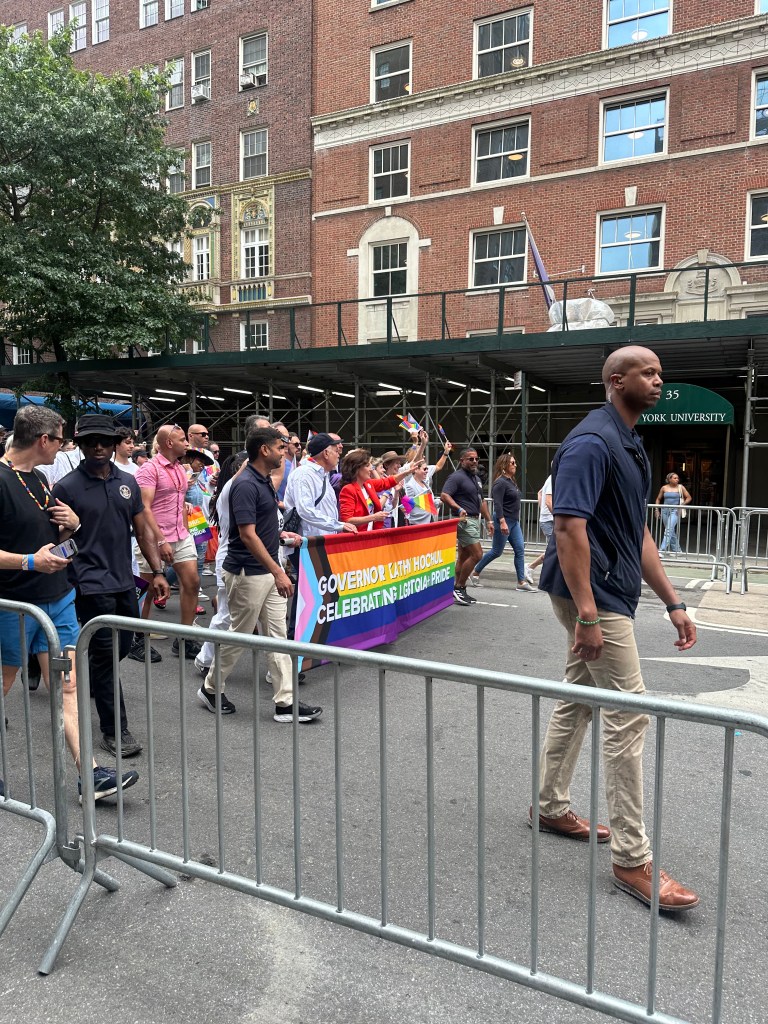
Here’s our governor, Kathy Hochul. I’m not too happy about her pausing congestion pricing for the MTA that would have gone into effect today.
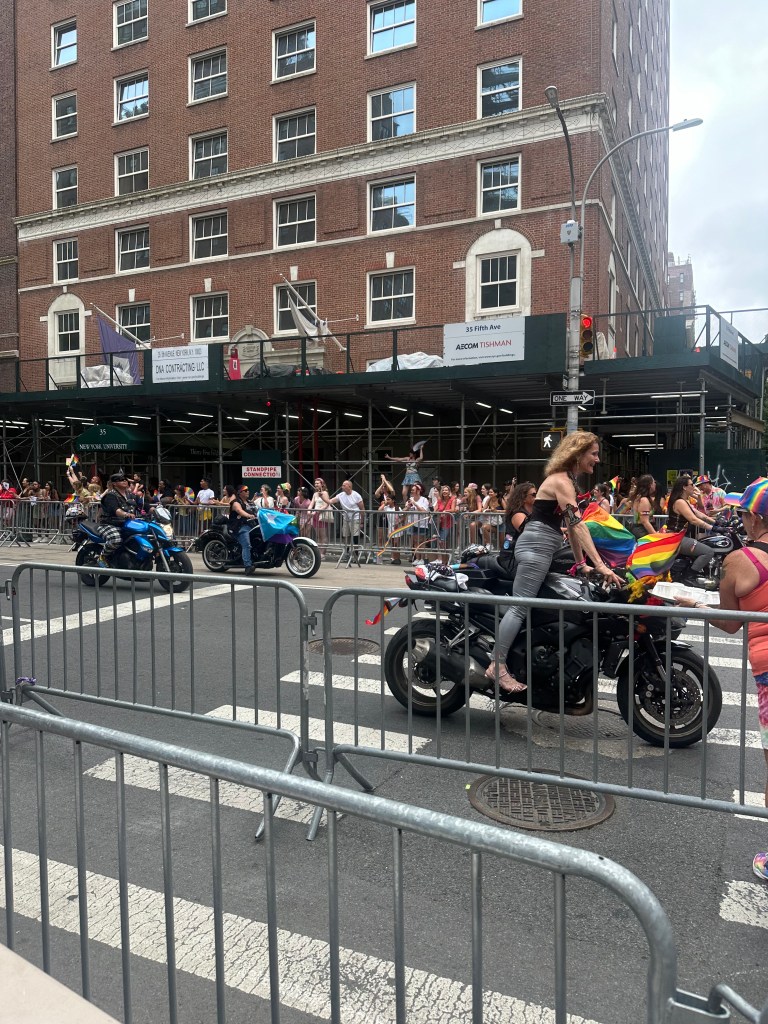
Here are some Dykes on Bikes.

See the gal in red: she was a volunteer with the Church handing out water just like me. The balloons are passing by.
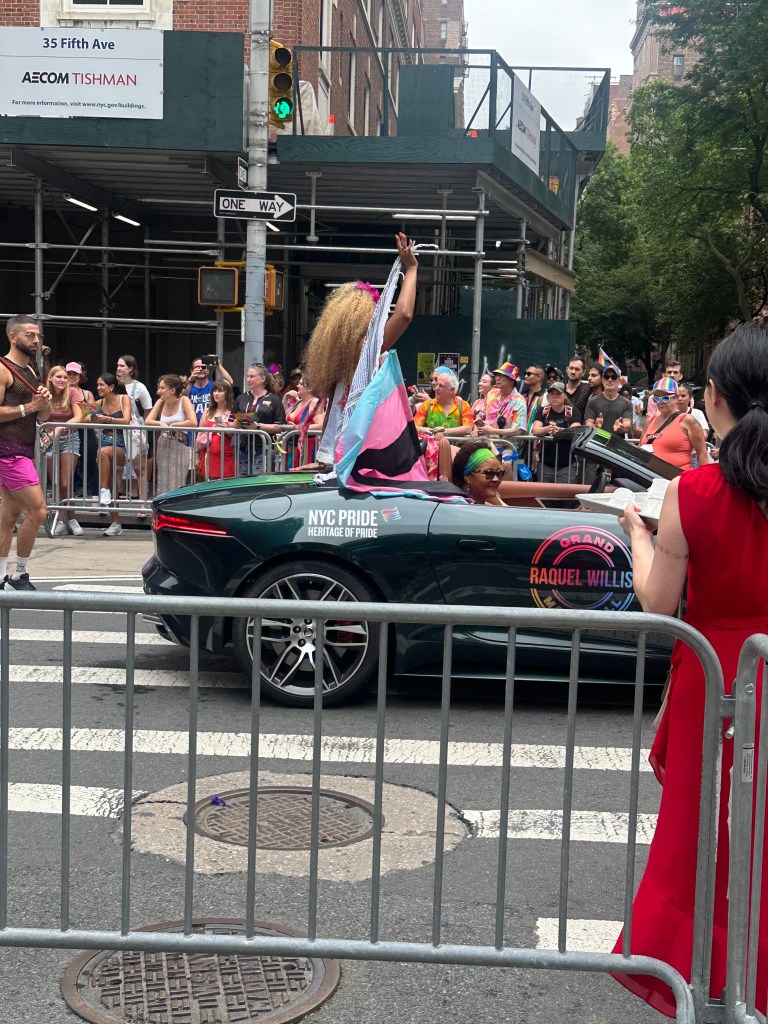
Here is one of the Grand Marshals, Raquel Willis. I didn’t know who she was, so I looked her up: She is an African American writer, editor, and transgender rights activist. She was born in 1990 or 1991, in Augusta, Georgia. Too bad you don’t see her face in this pic.
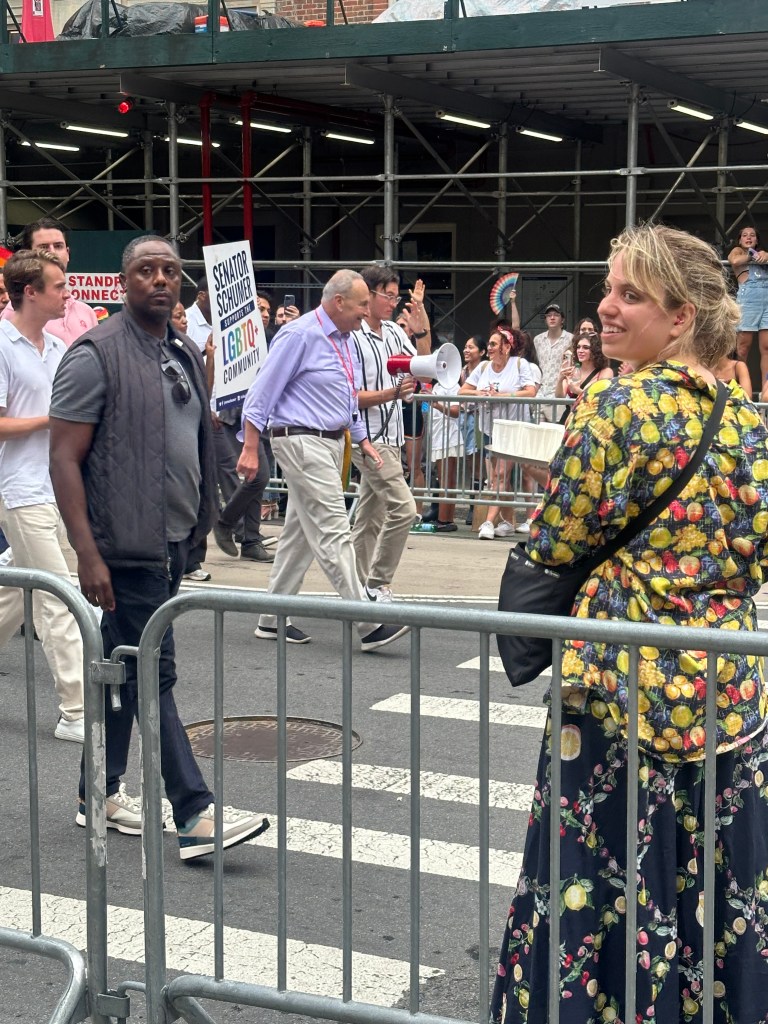
Here is Senator Schumer, who always proclaims that he was an early proponent of marriage equality in the state after his own daughter came out and married her significant other. Unfortunately, that’s the extent of my Pride March pictures, since it was after this time that I was pressed into service to hand out liquid refreshment to the marchers.
 And So It Goes