Today is Sunday, August 24, 2024. Now that the DNC is but a memory, analyses of the spectacular moments culled from four days of historic speeches given by such heavyweights as former president Barack Obama, his wife, Michelle, former first lady Hillary Clinton, and her husband, former president Bill Clinton (who was, sadly, not as powerful as he once was), and even tv personality Oprah Winfrey are being written, but there is one analysis that shines a spotlight on the one unforgettable moment of the convention: Gus Walz’s impromptu expression of joy over hearing his father up at the podium delivering his acceptance speech. Kevin Fallon for the Daily Beast writes an article referencing this one moment from the Democratic National Convention (DNC), in “Gus Walz Sobbing With Pride Is the Most Important TV Moment of the Year.”
Fallon writes that the DNC delivered something unexpected and that was – joy. Imbued with this in their mission statement, it’s why such speeches were infused with it: Oprah’s ebullient speech, with her bellowing at the end, “Kamalaaaaaaaaa Harris,” the Obamas, especially Michelle’s fired-up speech that called for everyone to “do something” to elect Kamala Harris as the next president, and Hillary Clinton’s victory lap. Everyone noted that hope was in the air, it was palpable, and it finally was felt – after years of polarization, division, and anger brought on by Trump and his ugly minions.
Also, every good speech took down the 78-year-old whiner by the name of Donald Duck. Barack Obama mocked Little Donnie’s obsession with crowd sizes and gesticulated that it all has to do with Donnie’s penis size.
As for that foundation of joy observed at the DNC, Fallon states that “the most important television moment of the year was an emotional Gus Walz overwhelmed with pride as his father, Tim Walz, accepted the nomination for vice president.”
You know the moment now, if you’ve seen Walz’s acceptance speech. When Walz mentions how important his family is to him, the camera cut to Gus, age 17, completely overcome by the energy. “That’s my dad!” he clearly shouted, as tears streamed down his face.
In essence, the symbolism of the DNC is encapsulated in this: “the confluence of something as abstract as patriotism with something as intimate and relatable as a parent’s love for a child created a blockbuster, ecstatic moment of television.” The whole four days succeeded in making us feel once more.
That moment of Gus Walz crying over seeing his dad accept the nomination did lead to some cynical and critical jabs from those on the far right, especially the odious Ann Coulter, who posted a sickening reply to Walz’s emotional response, and was forced to delete her post because of backlash from those who took offense at her comments about the Minnesota governor’s son. What heartens this writer “is that the reaction to any ridicule has been deafeningly supportive.” For this was a TV moment and “it was one that realigned our presumptive values.”
Hopefully then, the one lesson we can take from the conclusion from the Democratic convention is that more of us have a clear choice between voting for a more unified, inclusive society than the vision that Drumpf has set for America: one of decline and division. Why would anyone want the latter as the overarching vision for this country is beyond me!
Today Elliot and I had a pleasant day in Manhattan, where we brunched at the Ukrainian restaurant Veselka, located on 2nd Avenue and 10th Street, and then walked over to IFC, where we saw a new gay film called Sebastian.
It’s the story of a young Londoner by the name of Max who adopts the identity of “Sebastian” when he trolls social media as a sex worker and has sex with much older men. By day, he works as a freelance writer for a culture magazine called Wall and is a writer of short stories that have appeared in Granta. Sounds like a very nice resume, no? But Max doubles as an escort at night and is soon attracted to an older client, Nicholas (Jonathan Hyde) who tells him stories of himself as a much younger man living in the age of AIDS. When he is finished with these hookups, Max eagerly retreats home to his laptop, incorporating his private interactions into his prose. The film follows him into his memories, with brief, jittering flashbacks that signal his recall of tactile details and moments of vulnerability.
In the role of Max/Sebastian, we have Scottish actor Ruaridh Mollica, who does an adequate job of displaying Max’s hesitancy in tackling his night identity, especially when he uses it to further his ambition of becoming a serious writer. Oh, and there is a whole set piece at the beginning of the film in which Max is tasked with interviewing real-life queer writer Bret Easton Ellis whose own reputation for queer autofiction is an acknowledged influence on this film by Finnish writer-director Mikko Makela.
Even though we don’t know how Max really feels toward his dual identity (he does tackle the sex scenes with great vigor), he does seem to be genuinely attracted to his last client, Nicholas, who offers a definite dad substitute. There is no mention of Max’s relationship with his own dad, even though he does talk to his mother who worries about him and wonders how he’s able to write such compelling stories. If she only knew!
To see this film, we were seated in Theater 4 with not one woman present in the audience. I thought that was an interesting detail. Anyway, this film is not for everyone, it’s obvious, but if you enjoy seeing a new presence on screen, go see this intimate look of a new digital age sex worker.
Have a good week.
Stay safe and be well.
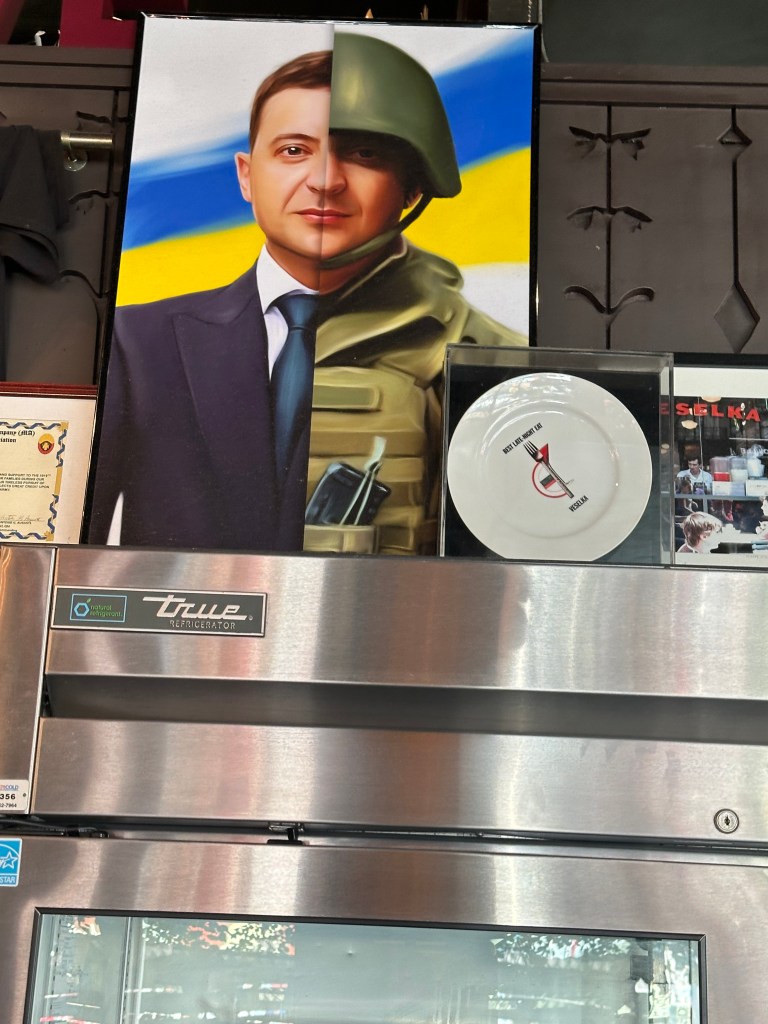
Here is a picture of Ukrainian president Volodymyr Zelenskyy at Veselka.
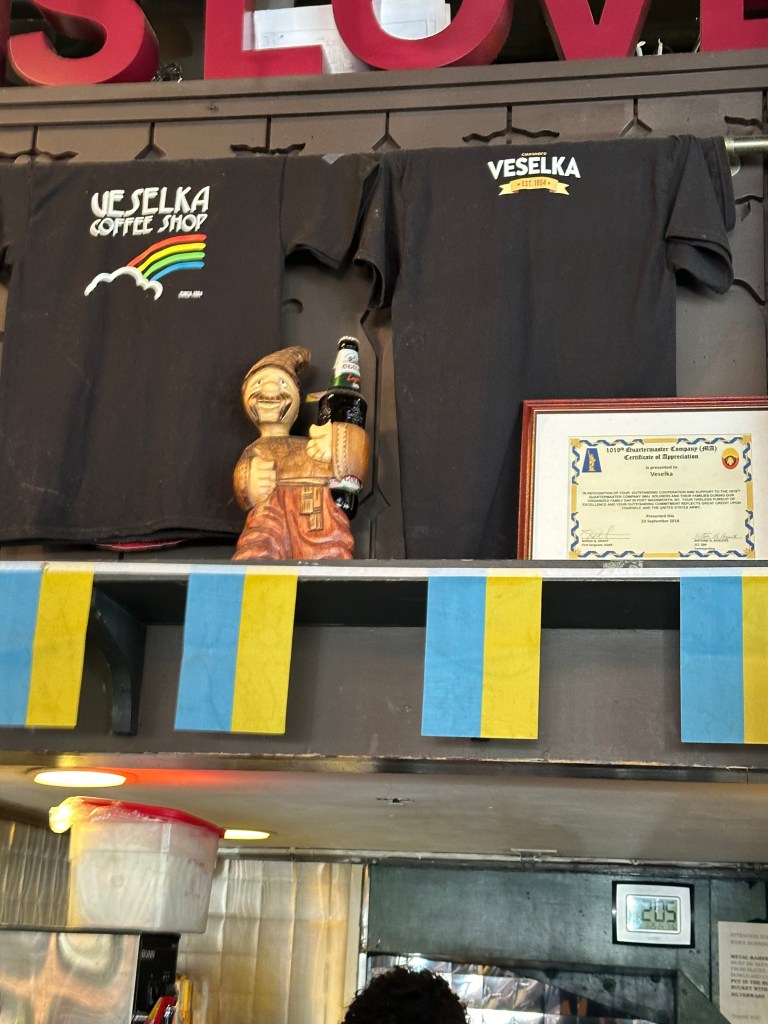
Some T-shirts plugging the Ukrainian restaurant here on display.
 And So It Goes