Today is Sunday, January 11, 2026. Yesterday, I was absent from this venue because I was immersed in culture by attending the premiere of a film at the Museum of Modern Art with my newish friend “Daniel.” The film was called Lumiere, Le Cinema! and it went on in the MoMA theater at 6:30. For anyone interested in the origins of cinema, this is the film to see because it covered the launching of worldwide cinema as envisioned by two French brothers, the Lumiere brothers, at the end of the nineteenth century. The two brothers, Louis and Auguste, were the ones who developed a camera-projector called the Cinematographe, the forerunner of today’s movie projector.
What the 90-minute or so film explored were over 125 snippets of film that were preserved and restored in France which made up the canon of the Lumiere Brothers catalog. The very first introduction to world cinema was the 50-second “Workers Leaving the Lumiere Factory,” which consisted of a long shot of people sauntering out of the Lumiere factory, in which quite a number of people stared directly into the camera as they walked past the camera operator. Hardly the stuff of modern cinema, you would say. But we all have to start somewhere, and the Lumiere brothers showed us the way. I’m sure some people reading this would consider this documentary a snooze fest, but some of the footage accurately captures what life was like in the late 1890s.
Interspersed with these little vignettes were scenes of New York toward the turn of the century. Some of the found footage could accurately be described as the first kind of home movies ever shot, as the brothers frequently placed their own families in these shots. There are scenes of family members swimming and enjoying birthday celebrations. And there is even the very first cat video in this trove of early Lumiere Brothers films.
After the screening, there was an interview with Thierry Frémaux , who is the director of the Cannes Film Festival and the Institut Lumiere. I’m not sure of the name of the person who interviewed Fremaux; he was definitely associated with the museum. Mr. Fremaux was very knowledgeable about the history of these early filmmakers, but Daniel and I had some trouble grasping what he said in his very thick accented English accent.
The entire presentation ended a little after 9, and we were quite hungry, as our hunger for culture was satiated with this absorbing documentary. So we headed toward a Japanese restaurant called Kiku on West 55th Street. When we got to the unprepossessing entrance to the site, we had to walk up a flight of stairs to a very small area consisting of a few tables and chairs. The place looked more like a takeout eatery than a sit-in restaurant, and we were the only customers there at the time. We asked the server how late does the restaurant stay open, and he said, 10. It was already past 9 when we got there. But he still took our order and didn’t indicate that we should leave.
Since I consider myself a tyro when it comes to Japanese food, I asked Daniel – who is Korean – what delicacies should I decide to have, and he indicated I should choose either teriyaki or tempura. I went with chicken teriyaki that came with miso soup and rice. Daniel decided on having a bento box that had a lot more than my chicken teriyaki.
Today was another day of culture, as I met my childhood friend “Harold” at the Whitney Museum, on Gansevoort Street. Again, I went alone; Elliot preferred to stay home with our dog-cat, Atticus. I had a ticket for 12, while my friend got in at 10:30, I discovered. I woke up at 9 and this time had breakfast at home, which is rare for me.
When I arrived, I texted Harold and he came down for me. I tried to get a coffee at the first-floor Frenchette Bakery at the Whitney, but as I was to find out, there was no seating there unless you sat inside for waiter service, which was not what I wanted. I learned there was a cafe and seating up on the 8th floor, so I told Harold I would go up there first, before browsing the museum.
After I had my coffee, I walked out to the exhibits on the 8th floor which consisted of Alexander Calder’s “Circus at 100,” which featured a video of the artist starring as the master of ceremonies at his own circus. The rest of the exhibit consisted of his wire figurines behind plates of glass.
Eventually, I went my way down to the fifth floor that featured the exhibit, “Sixties Surreal,” which is ending on January 19. At that point, I met Harold and we both walked through it. At that point, I had problems with my phone’s wi-fi reception and couldn’t reach Harold. But we still were able to meet up and go through this fascinating exhibit.
After going through the museum for more than three and a half hours, I started to get somewhat exhausted. By 4:30 or so, it was time to leave the building. Harold agreed this time to exit with me, since he was there since 10:30, which was about 90 minutes earlier than me.
From the Whitney, we found our way toward the Bus Stop Cafe, located on Hudson Street. That’s where we had a very lovely dinner. I ordered the butternut squash soup as an appetizer and had a chicken salad platter, while Harold requested the eggplant parmigiana entree. As is our wont, we both liberally shared each other’s fare.
Thus ended a very culturally fulfilling weekend, one that I haven’t had in a long while.
Tomorrow is our wellness checkup for Atticus. He hasn’t been out of the apartment since last January. We have an 11:30 a.m. appointment, so I’ll have breakfast at home once more.
Have a good week. Let’s hope there is no more disruption or violence at the hands of this regime like what had just transpired last week in Minneapolis.
And so it went!
Here are a few photos from today’s visit at the museum.
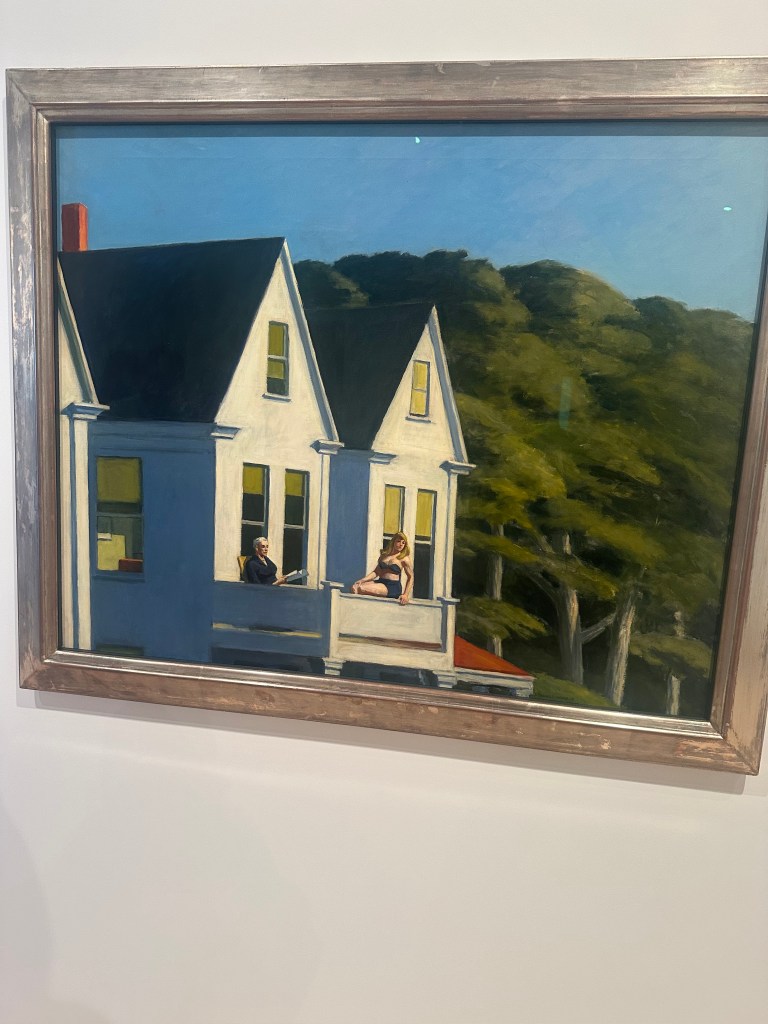
Who do you think painted this? If you said, Edward Hopper, you’re absolutely correct. It’s called Second Story Sunlight, and it was painted in 1960.
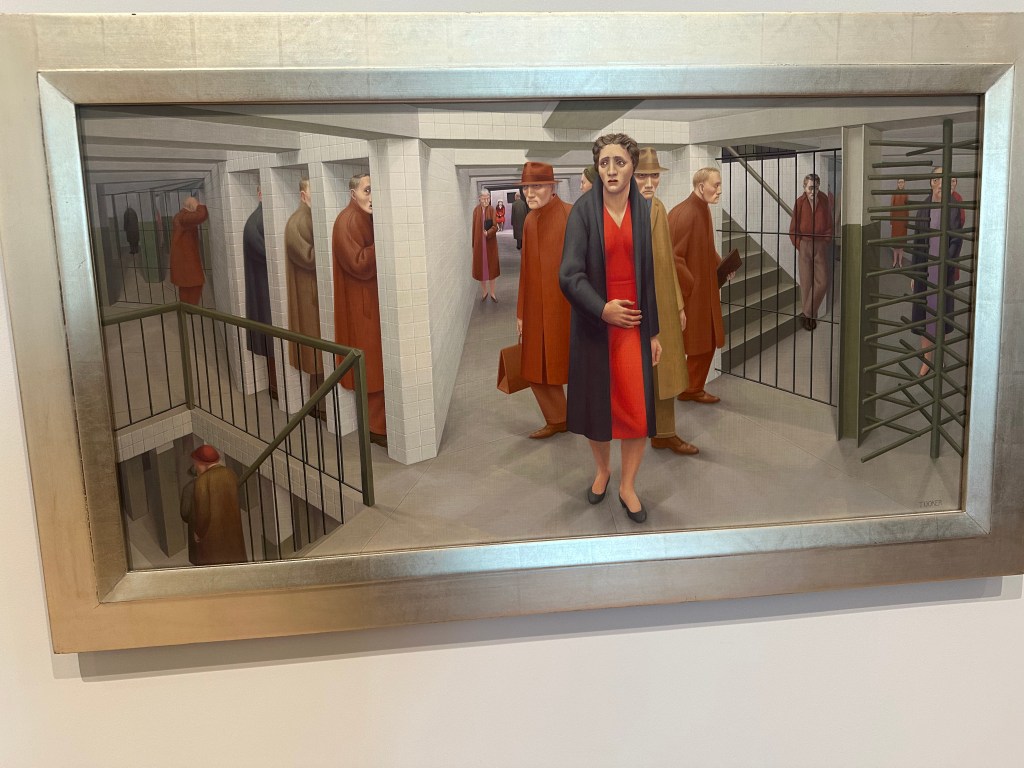
This painting is not as well known as the Hopper. It’s called The Subway and it was painted by George Tooker. Isn’t it a weird tableau?
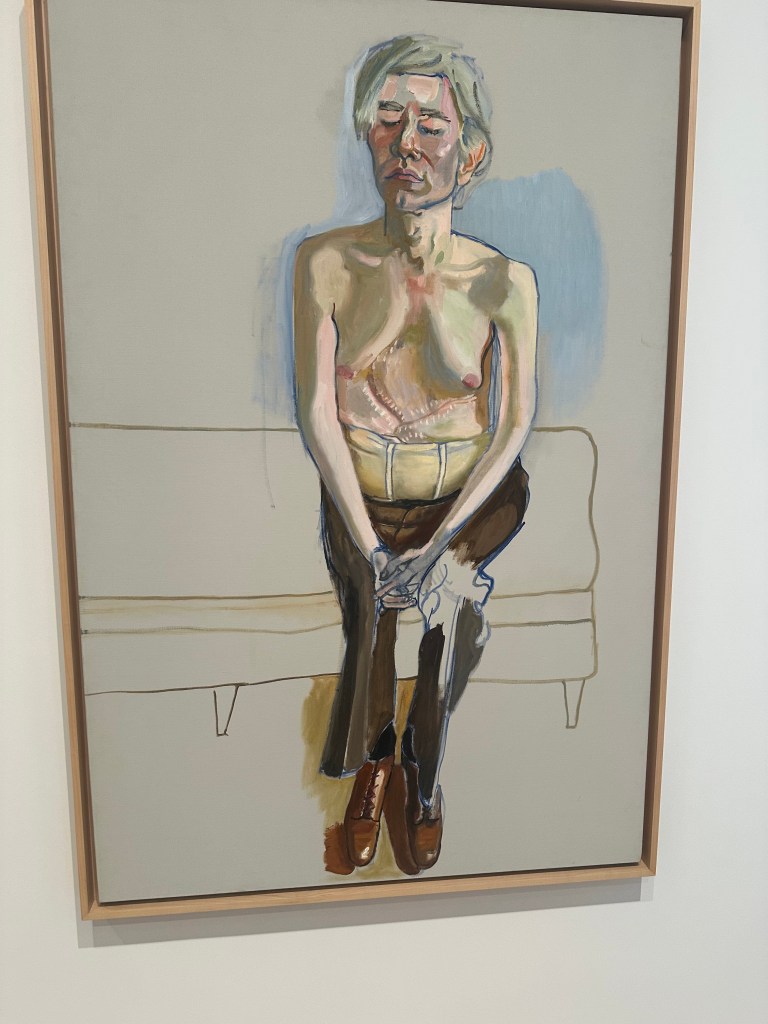
Can you guess who this once-famous public figure is? If you guessed Andy Warhol, you’re correct. Here the artist who painted this is Alice Neel, and the painting is aptly called Andy Warhol. The Pop artist’s vulnerability is shown here by Neel who depicts him with his scars and corset that he wore after being shot in 1968.

Can you guess who this woman is? A hint: she is the person for whom this museum is named after. If you guessed Gertrude Vanderbilt Whitney, you’re correct. The painting is called just that and it was painted by Robert Henri.
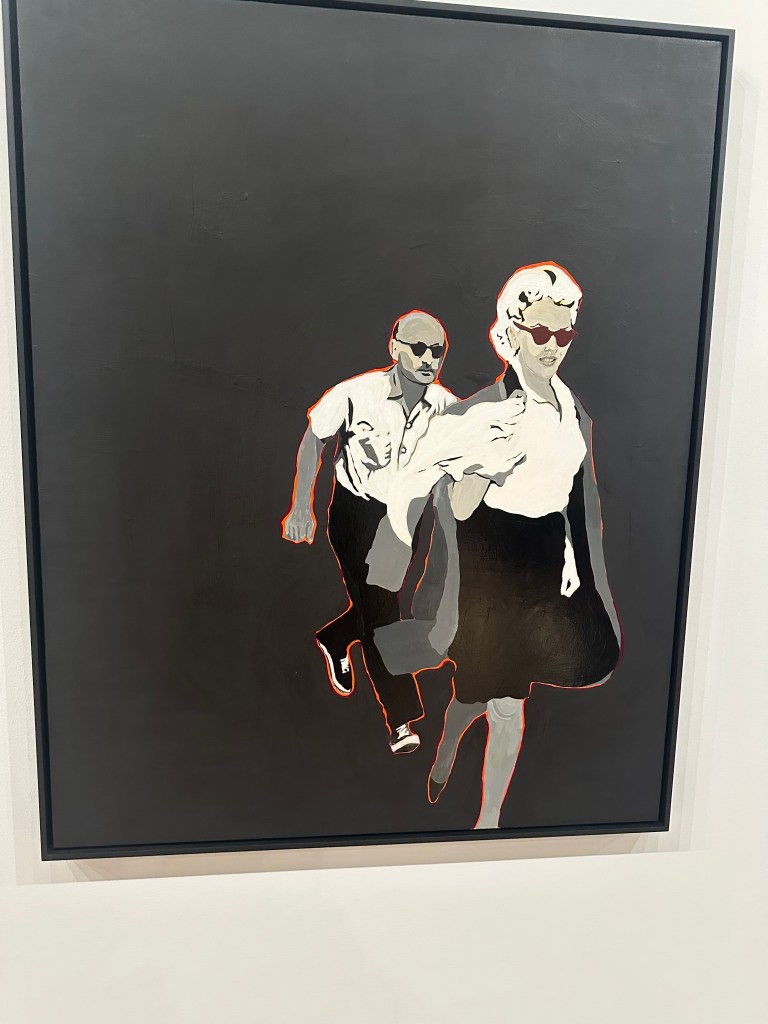
This striking picture is called Marilyn Pursued by Death, and the artist is Rosalyn Drexler, and it was painted in 1963. Can you tap the celebrity figure who seems to be running away here? If you guessed blonde bombshell Marilyn Monroe, you’re correct.
 And So It Goes