And So It Goes

Today is Friday, October 31, 2025. Happy Halloween, ghosties! As you know, I was going to brave the brutal weather yesterday in seeing Psycho in concert at the David Geffen Hall at Lincoln Center, with the New York Philharmonic playing the inimitable score of Bernard Herrmann on stage. For those not familiar with Hermann’s scores, I’ll provide you some background information on this man’s illustrious career later on.

Yesterday the weather was quite rainy and windy, and I had no intention of giving up my ticket to this groundbreaking film that gave birth to the modern horror film by staying home. So I took my trusty pink umbrella, put on my blue-zippered jacket, and left the borough around 3. I was scheduled to meet my friend “Harvey” at The Smith, located on 63rd Street and Broadway, around 4:15. However, I got to the West Side earlier than scheduled, so I darted into Breads Bakery for a cup of coffee and a croissant. Yes, I could still have dinner at 4:30 or 4:45 or even later after nibbling on a croissant just several minutes before.

As I was drinking my third cup of coffee, my phone rings, and it’s Harvey who says he’s already inside The Smith having a beer at the bar. I mentioned I was directly adjacent to the restaurant and that I would come by once I was finished with my repast.

After finishing my coffee and croissant, I walked directly across the street to the restaurant and spoke to a hostess inside. I mentioned that I had a 4:30 reservation and that someone could be here already. I saw Harvey right away; there weren’t that many customers having drinks at the bar at that time, and he started coming toward me.

We were ushered then to a table where we examined the menu and exchanged stories about traveling in this terrible weather. I mentioned I couldn’t believe how my umbrella didn’t self-destruct in these blustery winds.

Dinner was quite good; it consisted of us sharing crispy calamari and my having ricotta gnocchi, while Harvey had oysters initially. I eschewed dessert, but Harvey couldn’t resist the ice cream.

After dinner, we had some time to kill so we walked further uptown and, to our surprise, discovered another Strand Bookstore on 67th Street, I believe. Thus we browsed inside for a while before deciding it was time to head back to Lincoln Center. I almost bought an old Norman Mailer book on the Used Book shelves, but thought better of it.

Now to the concert that began a little after 7:30. The young conductor of the orchestra was Stephen Mulligan and there was a principal violinist by the name of Hae-Young Ham. They appeared on stage, while a large screen loomed behind them. That’s where we watched this 1960 thriller.

We were on the Second Tier, Door 22, Row DD, seats 2 and 3. We were in the last row in the back of the theater. That is the reason, I think, that we found the sound from the orchestra not as overpowering as we thought it would be. Also, the instruments used for the score were all strings here, and a note in the program explains why Herrmann decided to go this way instead of using a full-throttle orchestra for the menacing score heard throughout the shocker. The reason he did this, according to the program, is that he wanted “to complement the black-and-white photography of the film with a black-and-white score,” thus the use of strings only without the employment of woodwinds, brass, or percussion. In fact, Harvey asked me why there weren’t other types of instruments used in this show, and I pointed out Herrmann’s philosophy as the explanation.

Anyway, it seems as the audience thoroughly enjoyed this version of the film. I’m very curious to know how many audience members had seen this film for the first time last night. As I scanned the audience, I couldn’t make out many younger folk – like those in their 20s or 30s. But that doesn’t mean they weren’t there.

As I mentioned, Bernard Herrmann provided six scores for the temperamental director. He started with scoring Hitchcock’s 1955 principal comedy, The Trouble with Harry, 1956’s The Man Who Knew Too Much, The Wrong Man, also from 1956, 1958’s Vertigo, the espionage caper North by Northwest, from 1959, and 1963’s The Birds.

Herrmann was New York-born and bred and graduated from DeWitt Clinton High School in the Bronx (my former childhood birthplace), New York University, and The Juilliard School. He formed his own ensemble in 1931, the New Chamber Orchestra, to explore avant-garde repertoire. In 1934, he joined the staff of CBS as an arranger and rehearsal conductor. His scores for Orson Welles’s radio shows led to an invitation to write the music for two of that director’s films, Citizen Kane (1941) and The Magnificent Ambersons (1942). Thus began a 35-year record of writing musical scores for film and television that kept the composer quite busy. Herrmann died the night he finished scoring the music for Martin Scorsese’s Taxi Driver (1975). In total, Herrmann composed the scores for 51 films, not to mention a good many radio productions, television shows, concert shows, and even an opera.

As for Psycho, the film “set a horror standard for generations to come,” according to our program. It also depicted frank discussions of sexual situations and even mentioned transvestism at the end of the movie, which was quite unusual for commercial films at the time. Also, this was the first time a toilet was actually flushed in a film, when the doomed heroine, Marion Crane, portrayed by Janet Leigh, Jamie Lee Curtis’s mother, flushes a piece of paper down the toilet in her cabin, Cabin 1. This happens just before the shocking and infamous shower scene. If you really examine the thrusting of the knife here, you will actually see that the knife does not penetrate Leigh’s skin at all. This is so different from slasher movies today that depict the most graphic effects of being knifed by dastardly characters all the time.

Anyway, this was Halloween and you wouldn’t know it. We met Elliot’s daughter in Rockville Centre at Press 195, a sandwich and burger joint, where “Emily” paid for our lunch. She wanted to honor both Elliot’s and my upcoming birthday in November.

From lunch, we drove to see “Joseph” at the rehab center where he’s still staying and recovering from surgery on a broken hip sustained in a fall at the center. We stayed about an hour and brought him a slice of pizza and three Diet Coke bottles. He was very appreciative of that. Within 20 minutes or so, we were joined by his wife, “Mary.” This was our cue to leave.

It’s getting late here, so have a good weekend.

Oh, tomorrow Elliot and I will be attending a dinner at Beth-El, in Jersey City, a gala dedicated to Elliot’s late aunt’s estate funding of a refurbished community center opening tomorrow, so I’ll not be writing my blog on Saturday. The event starts at 7, and I don’t expect to be home before 11. I’ll see you on Sunday, November 2.

And so it went!
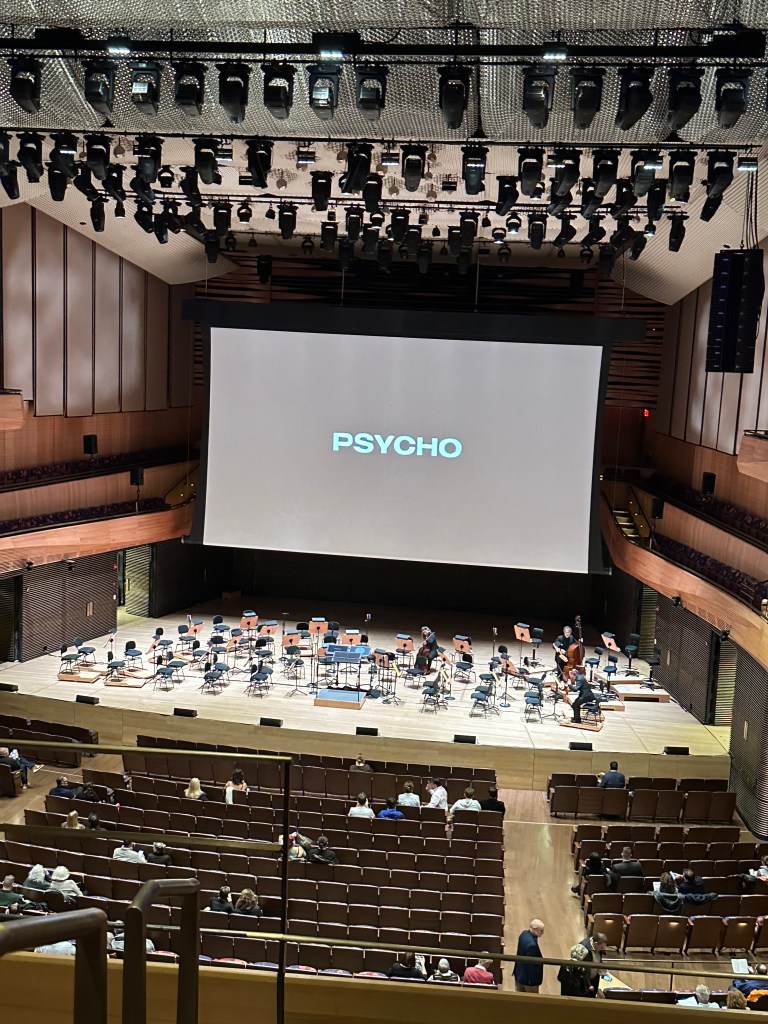
Here’s the auditorium early on before the film began at 7:30.
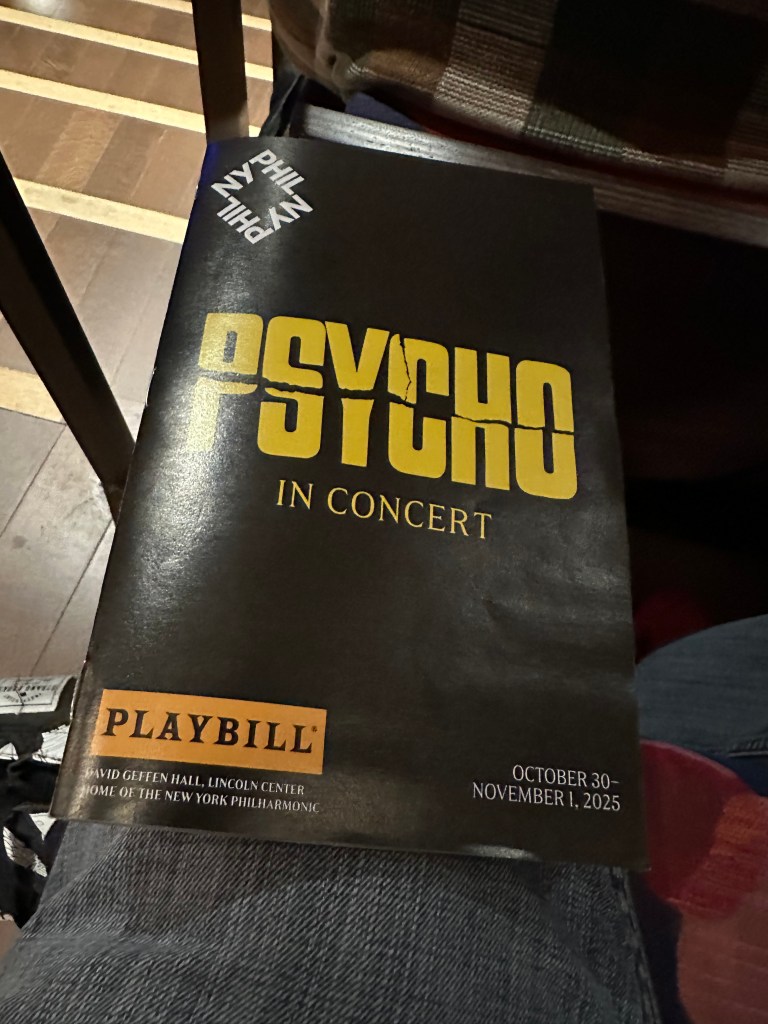
Here is the playbill from the program at Lincoln Center.
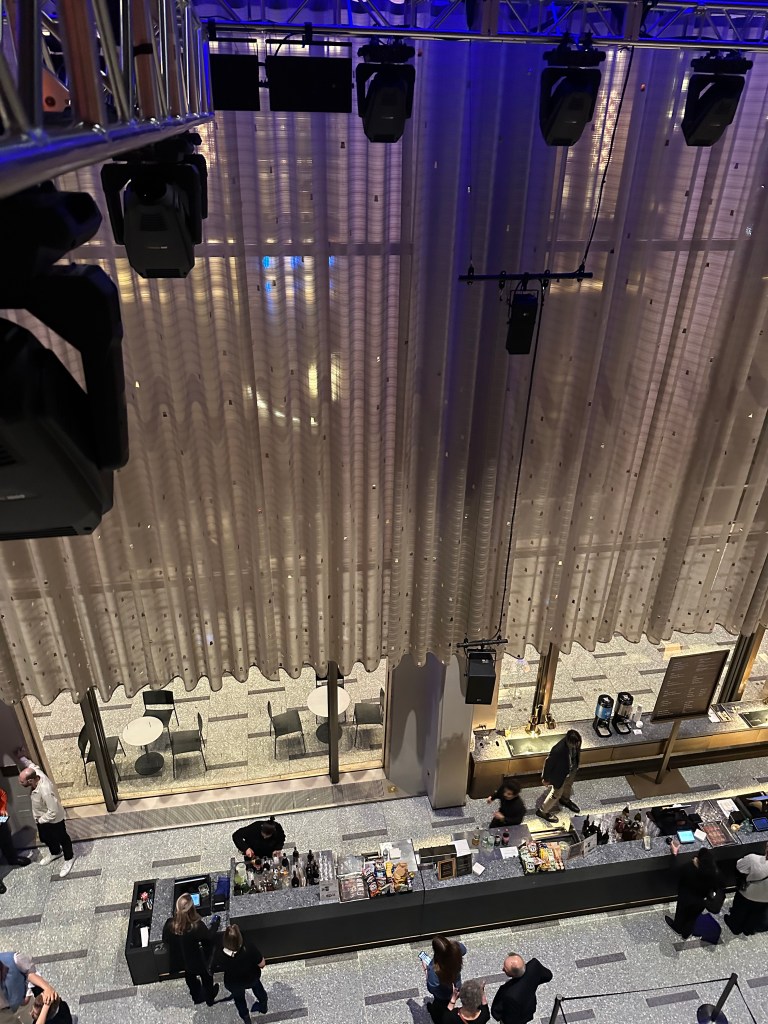
Here is a view from down below. Maybe I could be suffering from “Vertigo” by looking down.
And So It Goes

Today is Saturday, January 25, 2025. It’s getting late here so I’ll just write about the fascinating day that I had with my Astoria friend “Seth” that began at 11 a.m. We first had breakfast at the Bel Aire Diner, located near Seth’s house, on 21st Street. This was one diner I actually never dined in before, so I was quite happy.

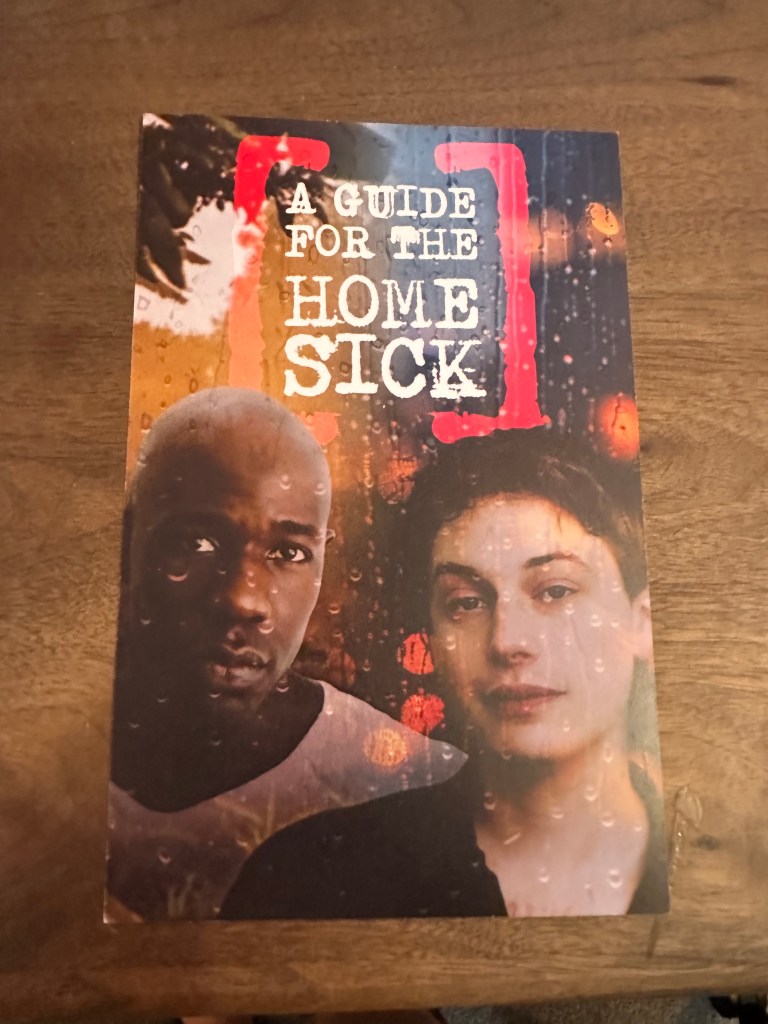
The play began at 3, so we had enough time to have breakfast and for us to take the subway down to 14th Street since the theater, the DR2 Theatre, was located on 15th Street. This was a four-character play, as the same two performers played two more characters to round out the play. The actors, McKinley Belcher III and Uly Schlesinger, portray Teddy and Jeremy, two strangers who meet at a bar in a hotel in Amsterdam. The story starts harmlessly enough as Teddy invites Jeremy back to his room near the Amsterdam Airport. The two-hander is set in January 2011.

Harvard grad Jeremy (Schlesinger) has been in Uganda working for the past year as a medical assistant and now he’s supposedly headed home to Boston. That’s when he misses his flight and meets Teddy, a finance guy, who had been with another friend, Ed, who was about to get married but somehow storms out of the same room earlier. This is his straight travel buddy who has a psychotic break before darting out of the room.

The set features a bed in the middle of the room which becomes central to the action in this 85-minute tense drama. You see, Teddy eventually does make a play for Jeremy who freaks out – at least at first. Jeremy’s intense reaction to Teddy’s pass serves as a catalyst for the two men to interrogate each other about their sexualities, and as they explore their pasts, to discover what they’ve both done recently that might have led each other to cause the death of a friend.

In this modern retelling of Sartre’s No Exit, where both men are unable or afraid to leave the room until their secrets are revealed in the 85-minute production, written by Ken Urban, the play explores the guilt, selfishness, and self-deceit plaguing the two Americans as they grapple with the possibility that their questionable behavior may actually be drawing them closer together.

As the play proceeds, we’re introduced to the other two characters: Ed and Nicholas. Nicholas is Jeremy’s gay friend in Uganda who frequented the medical clinic where Jeremy was working. He reveals his love for a married man, Martin, and the two form a close friendship that is marred by the country’s growing homophobia and bans against the “sin.” Belcher portrays Nicholas as a soft-spoken, naive man who isn’t aware of the eventual harm that will befall him as tensions flare up against homosexuals in his country. Schlesinger portrays Teddy’s manic friend, Ed, whom Teddy reveals his feelings for him right before his marriage to Margo. All throughout the production, Teddy’s phone rings and he’s afraid to take the call because of what he might hear.

As the play proceeds, the atmosphere becomes supercharged, with jarring changes in lighting that quickly shift scenes from Amsterdam to Uganda and from present to the past, as the mystery about the men’s pasts and the fates of their friends come into focus.

At the beginning of this shift, I was thrown for a little while as the two actors adopted different accents and dialogue. Then I understood that they were playing different characters in their lives. Reading a review of the play, I learned that Uganda has long suffered from entrenched homophobia, and that as recently as this past April, its courts have reaffirmed the 2023 Anti-Homosexuality Act, which puts the lives of LGBTQ+ people in mortal peril. I loved this ending quote from Pete Hempstead’s review of the play from December 12, 2024 in which he concludes, “It is a horrific thread [Uganda’s condemnation of homosexuality] to weave through a story of two men who come from a country that, supposedly, no longer punishes people for loving whomever they want to love. But then again, it doesn’t have to when it encourages us to punish ourselves.” As in Jeremy’s fear of identifying as homosexual as the phantom of his dead friend Nicholas haunts him even as far away as Amsterdam.

It goes without saying that Seth and I both enjoyed the play. I’m not sure when the play’s run is over, but if this synopsis of it appeals to you, then by all means, get tickets for it before it does close. I just looked it up: the play now ends on February 2, which is not too far off in the future.

After the play, we took the subway (No. 7) to Hudson Yards, which is an indoor upscale shopping mall on 33rd Street and 10th Avenue. It’s near the strange-looking structure called the Vessel which had been closed recently because of several suicides there. To me, it definitely looks like the carapace of some crustacean.

Seth wanted to browse inside Neiman Marcus, but when we entered the mall, we couldn’t find the store. We concluded that it must have closed, probably during COVID-19. Instead, we sat down to have coffee upstairs in the food court.

After this, it was time to ride back to Queens. I got off at Court Square to take the E, which exasperatedly, was not running. Thus I had to walk back to the 7 to take it to 74th Street where I then changed for the E train to Forest Hills.

Anyway, that’s the day.

Have a good Sunday. Tomorrow the weather is expected to be practically balmy, with temps to be in the high 30s, close to 40 degrees. Take out the bathing suits, folks.

And so it went!

This is the playbill from today’s play.

And So It Goes

Today is Sunday, January 19, 2025, a day until the coming Apocalypse. Maybe that’s why it’s snowing and it’s supposed to be frigid in Washington, D.C., where the inauguration has been taken indoors to appease a would-be dictator. Actually, the frigid weather is the story this week, as over 75 percent of the country is expected to face freezing temperatures this week as a rare winter storm approaches the South, in an online CNN article by Allison Chinchar and Lauren Mascarenhas examine this phenomenon.

But before I write about the weather, I must fill you in on the opera we saw at the Met last night: La Boheme. This is the 1896 opera fashioned by Giacomo Puccini about love among young Bohemians in 1830s Paris. According to the program we received when we walked to ur seats, “it can stake its claim as the world’s most popular opera.” The program also states that after the breakthrough success of Manon Lescaut three years earlier, this new opera established Puccini as the leading Italian opera composer of his generation.

So last night marked my debut at the Metropolitan Opera House at Lincoln Center and no one took notice! We had a rainy but warm day with which to take in my very first opera. I’m very glad the viewing wasn’t anytime this week, with temperatures supposedly not rising too much out of single digits. I hope meteorologists are exaggerating here, but we’ll see. It is snowing here now, by the way.

Before the opera, Elliot left the house much earlier to catch a film at Film Forum, an Iranian film that garnered a 95 percent Rotten Tomatoes rating called The Seed of the Sacred Fig that went on at 2:30 p.m. I eschewed going with Elliot to the movies since it would have been a much longer day than it could have been. I left around 3 to travel to the West Side to browse a little at the Westsider Rare & Used Books Inc. bookstore , located on 81st Street and Broadway, right opposite Zabar’s.

Originally, we intended to meet for dinner at 5:45 on the Upper West Side, at a restaurant called Amelie Bistro Wine Bar, located on Amsterdam Avenue, but we were forced to cancel it because Elliot would not have been able to travel uptown that quickly after the end of the film. His movie was over two hours long. He called me before I left to deliver this news, so I feverishly scanned the listing of restaurants near Lincoln Center to try to come up with a suitable alternative. Many restaurants whom I called did not have openings until 6:30, 7, or even later. I was compelled to make a reservation at an Italian restaurant called Felice 71 – Columbus, which was much closer to Lincoln Center anyway. The first restaurant was in the 80s, I believe.

I decided to give myself about two hours or so before I would have to walk to Columbus Avenue and 71st Street. So I went to Zabar’s first to have a bagel and coffee. This is not their premiere gourmet emporium, this is their take out and eat-in place, right next door. So I had a bagel there first before walking across the street to the used bookstore.

Then it was time for me to browse in the bookstore. I am reading my new gay men’s reading club selection which I had to order from Amazon since I was Number 35 on a list at the public library from which I initially ordered it. I thought this was ridiculous; I wouldn’t get that book until next year, perhaps. Thus I ordered it last week on a Tuesday and it came on Thursday. I’m on page 140 already. After diving into it over the last week, I can see why so many people want to read it. The story is fascinating; it concerns the adventures of an Iranian young man by the name of Cyrus Shams who has a background of loss and violence. His mother’s plane is shot down by American missiles in a horrific accident and his father dies very young after relocating Cyrus and himself to Indiana. Ali could only get work killing chickens at a factory farm in the Midwest. Cyrus himself is a drunk, an addict, and a poet, whose obsession with martyrs leads him to conduct an examination of those who sacrificed their lives for a worthy cause. Despite these quirks in his personality, there’s something very endearing about Cyrus and his longings. Also the writing is superb, in my opinion. Oh, the author of this book is Kaveh Akbar.

Anyway, I was in the store for about 40 minutes when I decided to start walking down to 71st Street. We had a 6:30 reservation for outside; I couldn’t get an inside table. And this was cutting it close since the opera started promptly at 8.

I got to the restaurant around 6:05 and was escorted outside to an enclosed bubble that seated two people. It was very cute, actually. The maitre d’ said that the enclosure had its own heat, and she wasn’t kidding. I had to remove my outer jacket because it was quite toasty with the door closed.

Elliot approached the outside enclosure around 6:20 or so and it was essential that we give our order to our server immediately since we wanted to leave before 7:30 if that were possible. We ordered some appetizers and then one main entree each. We eschewed dessert and coffee and managed to finish before 7:30. I’m surprised we didn’t get indigestion as we darted toward Lincoln Center after paying the bill.

Anyway, we managed to get into the opera house with no fuss and we got to our seats. I tried to see how people were dressed; what I could see was that not too many people were dressed too lavishly there. I wore a suit; Elliot had on good slacks and a sweater. Maybe I expected men to be dressed in tuxedos and women garbed in gowns and high heels. But I didn’t see much of that in evidence.

For the opera, I can’t comment on the music or the professionalism of the cast’s singing since I’m no opera maven, but I can tell you that I was not bored over the four acts of the performance. There were two intermissions and the acts were really not that long. Elliot, actually, walked out before the final act. He saw three acts and left after 10. I remained to catch Mimi’s gasping last breaths in Act IV and applauded with everyone else at the end. What really helped with my enjoyment of the opera was the digital display in front of me that provided the opera’s libretto as the principals sung the lyrics. I’m not sure when these displays were installed to enrich the audience’s understanding of the lyrics, generally sung in Italian. So you don’t have to be in the dark wondering what the hell was being sung by the characters on stage. I Googled one of the most well-known arias from the opera – “che gelida manina” (translated to “what a cold little hand,” when Rodolfo meets Mimi for the first time and they talk about themselves and fall deeply in love.) The lyrics to this aria are definitely very romantic and transporting. When I looked this up, I saw the immensely popular Pavarotti singing this aria to Mimi as Rodolfo. He was the world’s most acclaimed tenors, as you know.

Well, that’s all I can write about the first opera I saw. I do hope that this has whetted our appetites to the point of seeing other performances as time marches on.

Have a good week, despite what’s happening tomorrow in Washington.

Oh, I didn’t write about the weather. All you have to do is look out the window. So forgive me if I don’t reprise the particulars of that story I mentioned in the first paragraph here.

And so it went!

This is our program from La Boheme. However, the picture on the front is from Aida, not the play we saw last night.

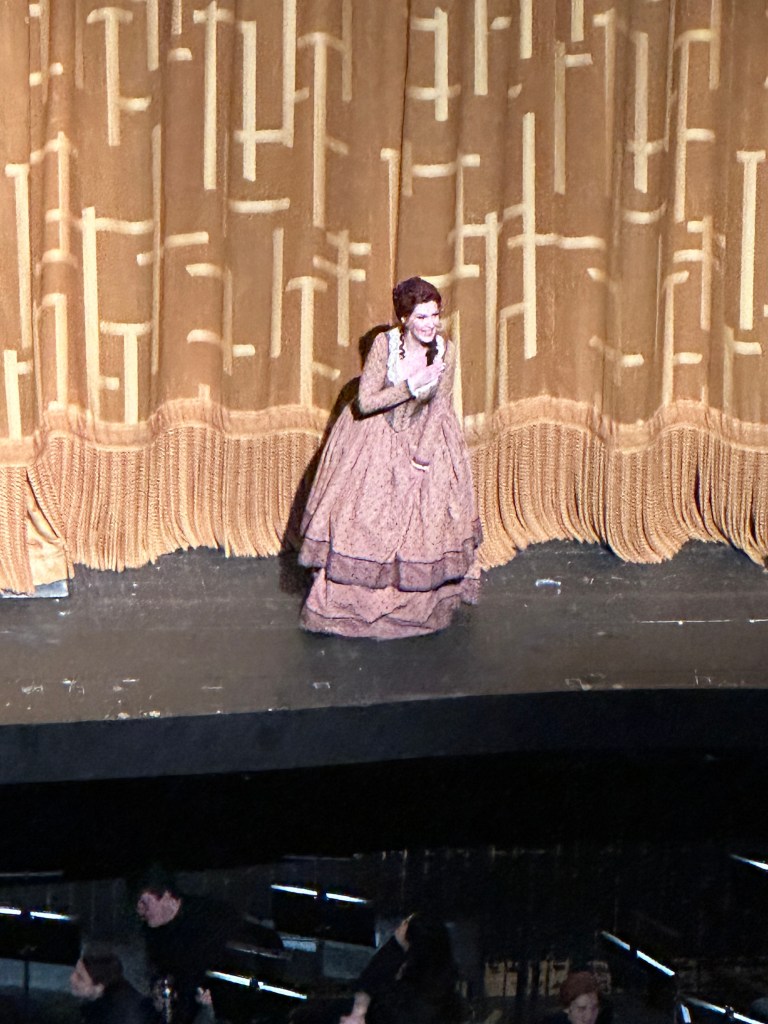
This is Musetta (Adela Zaharia) taking her bow. She is the second female character in the play and she’s in contrast to Mimi who is sweet and good natured. Musetta is what you might call a “good-time girl.” She’s been around the track, as they say.

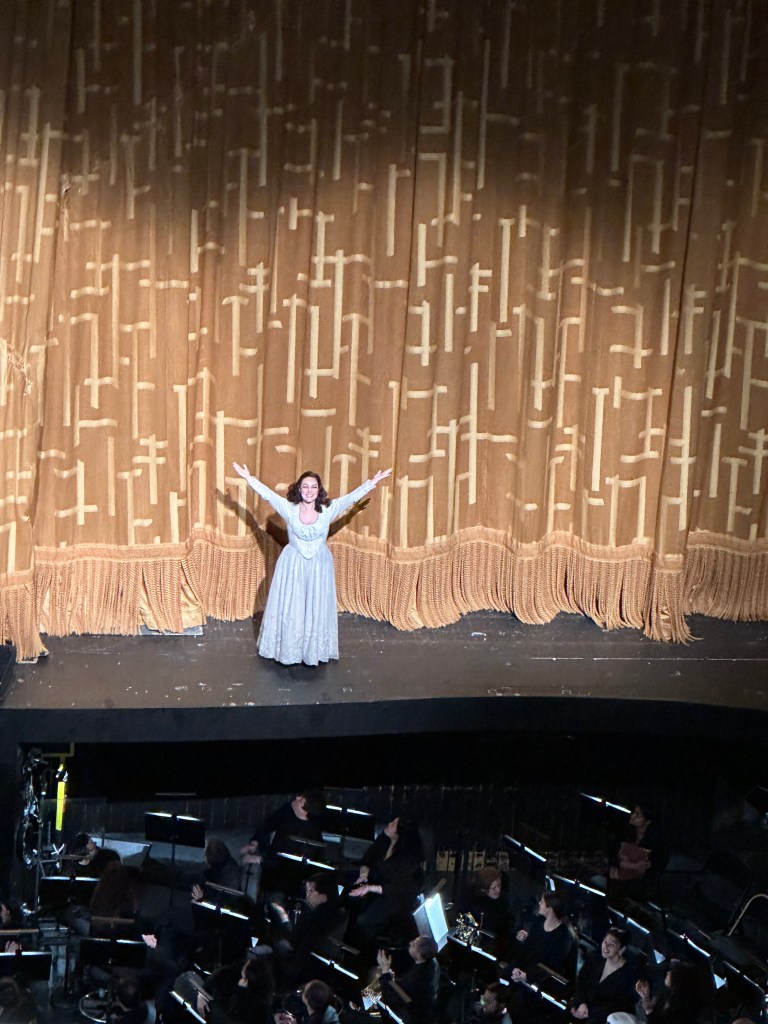
This is the fair Mimi (Eleonora Burrato) herself.

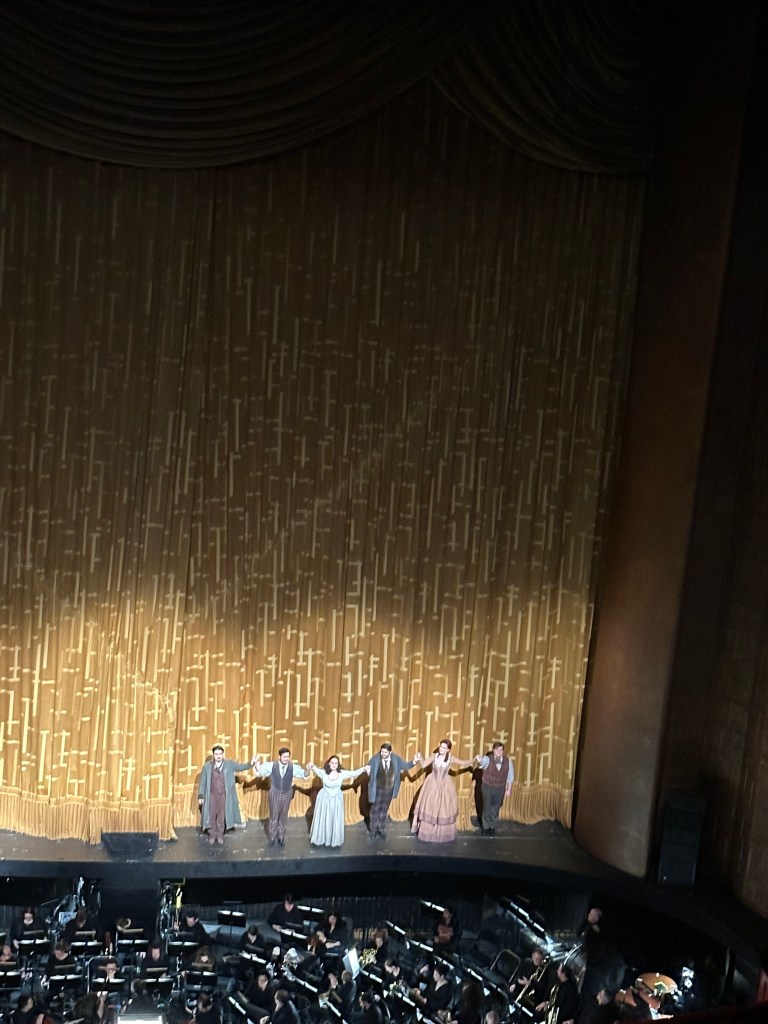
This is the entire cast who performed in La Boheme. There are Mercello and Musetta who are an item, but they’re always quarreling, Mimi and Rodolfo and two other artists, Colline and Schaunard. Colline is actually a philosopher, while Schaunard is a composer. In yesterday’s performance, Rodolfo is sung by Yongzhao Yu.

And So It Goes

Today is Sunday, December 22, 2024. As I wrote yesterday, I didn’t file an entry here yesterday since I was with my Central Islip friend “Jake” for close to 12 hours. He left a little after 1 a.m. instead of at 12:30 which we agreed on the last time he spent his time with me. The reason for this is that I put on a heartwarming holiday film from 1947 that was aired on TCM called It Happened on 5th Avenue starring a cast of recognizable names from that period, names like Don DeFore, Gale Storm, Charlie Ruggles, Victor Moore, and Ann Harding.

It’s an uplifting paean to the bounty of friendship and what is truly essential during this overly materialistic holiday season. The plot involves a drifter by the name of Aloysius “Mac” McKeever (Victor Moore) who uses the vacant, luxury townhouse of rich businessman Mike O’Connor, here played by Charlie Ruggles, as his residence during the winter while O’Conner winters in Virginia. Soon Mac invites an unemployed veteran, Jim Bullock, played by DeFore (who played the boss of Hazel in the 60s situation comedy starring Shirley Booth) who is evicted from a building owned by O’Connor to stay with him in the mogul’s townhouse. Before long, McKeever is hosting a passel of friends of Bullock’s who are homeless like he is because of a housing shortage. Then to mix up the Irish stew of residents of O’Connor’s 5th Avenue posh address comes O’Connor’s own 18-year-old daughter who is escaping from a boarding school that her father enrolled her in; she disguises who she is and passes herself off as Trudy “Smith” and immediately falls in love with Jim Bullock. Then true mayhem ensues as the real O’Connor goes looking for his daughter and is recruited to pass himself as just another vagrant by his daughter and takes residence in his own house as an unwelcome guest. This is the kind of madcap comedy and human drama that was usually directed by Frank Capra in many 30s and 40s films. Thus this movie has what is called a Capraesque feel to it, even though it was directed by someone else. Jake and I enjoyed the film and he didn’t want to leave before the movie ended, which was at 1 or so.

Anyway, Jake arrived earlier than I expected. I’m glad I put out all of the goodies before 1, since he buzzed downstairs a little after 1. I mentioned that he was early, but he just ignored that. After the customary hugs, we sat down on the couch and caught up on the last three months or so. The conversation ranged from the trivial to preparing for one’s own demise. Pretty heavy, I would say.

At some point, I entertained Jake with my proposal for going to the Kew Gardens Cinema and seeing the new Jesse Eisenberg film A Real Pain, and he concurred it would be a good idea. He didn’t want to see Wicked which was playing there as well, as it was a far longer film than the movie I had suggested seeing, which was only about 90 minutes. The time for our film to begin was 6:45 so we talked until about 5 and headed out in the frigid cold. But we took our old car which was just parked on the next block abutting the building, so we didn’t have to walk very far to it. I would have wanted to show Jake the new car, but I didn’t want him slipping on ice on the way there.

I found a spot far up the way from Lefferts Boulevard on the right, so we had somewhat of a walk to the theater and it wasn’t easy for the two of us, given how bitterly cold it was.

We got to the theater in enough time to buy two tickets and to see all those mindless ads and trailers for new films before our intended movie began. And then the film started! What can I say about this jewel of a film? It’s quite short – as I said, about 90 minutes – but it packs a narrative wallop that will leave you quite charmed.

From an original screenplay written by Eisenberg himself, the story recounts the adventure of two mismatched cousins, played by Eisenberg as David Kaplan and Kieran Culkin as Benji. These two dissimilar young men are scheduled to fly to Poland to join a tourist group for a week, where they’ll visit historical Jewish sites, as well as the house and area their beloved grandmother – who just recently died – lived. David is all wound up, with bouts of nervousness, as Eisenberg’s usual persona generally is, while Benji is a bit of an odd duck; he’s impulsive, while David is very strait laced, Benji is enormously erratic, prone to outbursts. He vacillates between being tremendously annoying, seemingly triggered by random events, and disruptive and inconsiderate to everyone in the Holocaust group.

The acting in the film is exceptional, especially Culkin’s interpretation of this thirtyish nonconformist who still lives with his mother in her house in Binghamton and is decidedly single, while his more mature cousin, David, is married, has a job, and is a father to one little boy.

Interspersed with this intensive character story are vistas of modern-day Warsaw and the World War II Majdanek concentration camp which are unsettling, to say the least. The film is really a showcase for Culkin as the out-of-control cousin who has lost touch with his more sedate cousin who is thrust into taking this historical road trip to discover how different he is from his relative.

I’d be remiss to mention that a more mature-looking Jennifer Grey (the star of Dirty Dancing) is cast in this film as one of the people on this historical Poland adventure. She plays wistful Los Angeles divorcee Marcia (I tell you, Jake and I didn’t recognize her until the credits). Other traveling companions in this small, tight group include a boring older couple – Diana (Liza Sadovy) and Mark (Daniel Oreskes) from Shaker Heights and soft-spoken compassionate Eloge (Kurt Egyiawan) who fled the Rwandan genocide and later converted to Judaism.

The tour guide is James (Will Sharpe) who is British and an Oxford scholar, who has an intellectual understanding of the statistics of history, but who later clashes with Benji over this kind of method of just dredging up facts and not connecting with the visceral connection to these landmarks. Their dispute occurs in an old Polish cemetery and it is here where David grows more embarrassed and exasperated with his “real pain” of a cousin.

The film was not only written by Eisenberg but directed by him too. I highly recommend the film; it’s a small but deftly perceptive comedic drama that deals with the various paths to dealing with pain, loss, and suffering, accompanied by the complicated upheaval of self-discovery. So see it if you can over this holiday season before Amazon Prime gets it on December 31.

As we walked back to the car and started driving home to a warm apartment, I looked down at my left hand and noticed – Egad! – my missing star sapphire ring. I lost the ring probably due to my finger contracting in the cold and it slipping off. (I was wearing gloves over my left hand.) I mentioned this to Jake and I suddenly got somewhat ill. But I never told Jake. I had to focus on driving us both safely back to Forest Hills. Then I could panic.

When we got back to the building, I left Jake off to take shelter in the vestibule while I parked the car on the street. I found a spot near the Grand Central Parkway and it was there I looked all over the driver’s seat and in the back, hoping to find my ring. I didn’t find it in the car, so I was resigned to having lost my newish ring on this cold December night. However, when I thrust my hand in my left-hand jeans pocket, lo and behold I found the ring right there at the bottom. To me, this is a holiday miracle of sorts. Or just good luck, if you want to characterize it as such.

Anyway, I happily told Jake my good news and we went upstairs where we greeted Elliot who was home from his wanderings and I made coffee for all of us. Then he repaired to the bedroom, while we watched It Happened on 5th Avenue in the living room.

Have a good week.

And so it went!

And So It Goes

Today is Thursday, December 12, 2024. Today the worst person on the planet, Donald J. Chump, has already indicated that that he won’t bring down grocery prices, a key promise that he ran on to gain a second term in the White House. I hate the fact that Time magazine named him “Person of the Year” in its latest issue (well, here’s another magazine I won’t be reading in the New Year) and it is here that he admitted, “It’s hard to bring things down once they’re up.” Resorting to his usual gibberish, Chump stated, “You know, it’s very hard . . . But I think that they will. I think that energy is going to bring them down.” Huh! What energy is going to bring down prices here? one must wonder. Then the jerk talks about the supply chain that was one of the major factors that caused food prices to spike during the pandemic: shipping availability decreased and freight times increased, contributing to shortages of imported food. But those issues more or less have since been resolved. Yet Chump talks about the supply chain decreasing prices, which is a fantasy right now. In an online article for CNN by Elisabeth Buchwald entitled “Trump just said groceries will be more affordable ‘very soon.’ He’s also said that might be very hard to achieve,” the implications of his breaking a key promise he made to persuade people to vote for him are outlined herein.

In retrospect, Americans did pay 22 percent more for groceries last month compared to when Dump left office in January 2021, per November Consumer Price Index data released earlier this week. And, compared to February 2020, before the pandemic, Americans paid 27 percent more for groceries in November.

Using an August press conference to draw attention to food inflation during his campaign for president, Chump fumed, “Grocery prices have skyrocketed.” Then he went into his mantra, “When I win, I will immediately bring prices down, starting on day one.” He continued, “We will drill, baby, drill,” referring to increasing domestic oil production. He said this action is “going to bring down prices of everything.”

As for crude oil production, December 6 hit a new record of 13.6 million barrels per day, according to federal data dating back to 1983. Experts have told CNN that drilling more, even if feasible, would not move the dial much in terms of lower grocery prices because of a plethora of other factors. Focusing on improving supply chains could prove to be a more effective strategy, though it will not be easy to tackle.

Even if Chump somehow miraculously helps improve supply chain issues (don’t count on it, folks), other policies he’s pledged to enact, including broad-based tariffs and mass deportations of migrants who entered the country illegally, risk raising food prices substantially.

On the deportation side, the food and agriculture industries rely heavily on migrant labor. Without it, those industries will likely contend with labor shortages, which, as a result, could force them to have to increase wages. The higher cost of labor would presumably get passed down to consumers in the form of higher prices. It could also result in food shortages if there aren’t enough workers to support food production, likely putting further upward pressure on prices.

Basically, folks, you are screwed now that your boy is back in the White House!

Today Elliot and I had a lovely day in the city seeing a thrilling action drama starring Jude Law in an atypical role, that of a world-weary FBI agent, tracking down members of a Neo-Nazi terrorist group in the Northwestern United States in the early 1980s. The film is called The Order and we saw it at the Angelika Theatre. What is very scary about the film is that it’s based on fact and it made me squirm in my seat because of its shocking verisimilitude. Law was breathtaking and very believable in the role of Terry Husk who is assigned to small-town Idaho and is soon embroiled in a missing persons case that exposes the origins of this Neo-Nazi group that finances its activities through violent bank heists, counterfeiting, and armored car robberies, not to mention a few murders here and there.

We had to leave early because our cleaning lady “Lareto” was expected to arrive by 10. Instead, she buzzed us downstairs by 9:30; but I had to leave the apartment to move our 14-year-old car to the Thursday side in order to avoid the alternate-side parking situation. Luckily, I found a good spot at 9:45 and waited in the car until 10.

So we left around 10:30 and walked to the subway to get the E. Our first destination was Veselka, the Ukrainian restaurant, on 2nd Avenue and 9th Street. Inside, we saw a mural that explained that the word “veselka” means “rainbow” in Ukrainian. Some of the dishes the restaurant is known for are pierogi, veal goulash, chicken paprikash, beef stroganoff, kielbasa, borscht, bigos, potato pancakes, blintzes, and other menu items. Eschewing the traditional dishes, I ordered pancakes with chocolate chips instead. Elliot did order vegetarian pierogi, however.

We had some time until the movie went on, which was 1:45, so we walked to two bookstores, Codex, on Bleecker Street, and the Mercer Street Books & Records shop. I admit to buying one book at the first store, a Primo Levi collection of personal essays on his surviving the Holocaust called The Drowned and the Saved which came out in 1986. Don’t ask me why I bought this book when I have over 500 titles I still haven’t read at home. Chalk it up to this being my kind of addiction, possibly.

Now as for the film that premiered at the Cannes Film Festival recently and received a standing ovation. The film is directed by Justin Kurzel and penned by Zach Baylin and it draws inspiration from the 1989 nonfiction book The Silent Brotherhood, authored by Kevin Flynn and Gary Gerhardt. Thus Law portrays the weary FBI agent Husk who teams up with a local cop, Jamie Bowen (Tye Sheridan), and sort of takes him under his wing when a local bad boy disappears and is found dead in the woods. Reading the reviews for the movie, I learned that there were two Brits – not one – cast here: Jude Law, who I already mentioned, and Nicholas Hoult who plays the charismatic but murderous leader of the Order, Bob Matthews. He is very convincing in his role as a family hater of the “other” who is impatient with the methods of the Aryan Nation that do not resort to such desperate measures as he does to finance an imminent race war. During a meeting of the Aryan Nation, he stands up and condemns the leader for only talking and not doing anything.

In addition to his small army of social outcasts taking part in bank robberies and bombings of porn theaters, Matthews orders the assassination of radio talk host Alan Berg (here played by comedian/podcast host Marc Maron) who is killed gruesomely in front of his house because he condemned such terrorist groups on his show and also because he was a Jew. Now the die is set. As Husk, Law is not his usual sexy self; here he is older looking, with a droopy mustache, and puffy features. He definitely looks the part of a seasoned FBI veteran who is assigned to reopen the bureau’s dormant Idaho office and is presumably hoping to find a house for his wife and kids (whom we never see).

Before long, Husk is thrust into the investigation of the local white supremacy group and is hell-bent on capturing Matthews and his dangerous crew. He is soon aided by family man Bowen and bad-ass Jurnee Smollett as another fellow FBI agent.

The film packs several thrilling action sequences as the FBI descends upon a local hotel for their man and the bullets fly all over the place. All in all, The Order is a gripping crime thriller that hits too close to home, considering what transpired on January 6, 2021, reflecting the current state of white supremacy that lurks within the gutters of American society like a hidden disease, which can surface at any time when we let our guard down. Remember, the events of this film took place here over 40 years ago and these groups have never been totally eradicated in that time!

I wholeheartedly recommend this film to everyone since its theme is still resonant today. Also, I have a book on the life and subsequent murder investigation into the death of Alan Berg, the Denver radio host who was killed by these hateful terrorists, called Talked to Death: The Murder of Alan Berg and the Rise of the Neo-Nazis. This book probably has more details about the Order and the people involved in the organization if you’re interested in reading about them.

Tomorrow Elliot and I are driving to Arlington, Massachusetts, to spend time with Elliot’s daughter and her family. We’re actually going to use the new car for this little motor trip. I’ll be home Sunday.

So have a good Friday and a very pleasant weekend.

And so it went!

We walked to Rockefeller Center to see the tree, and here it is.

There it is again!

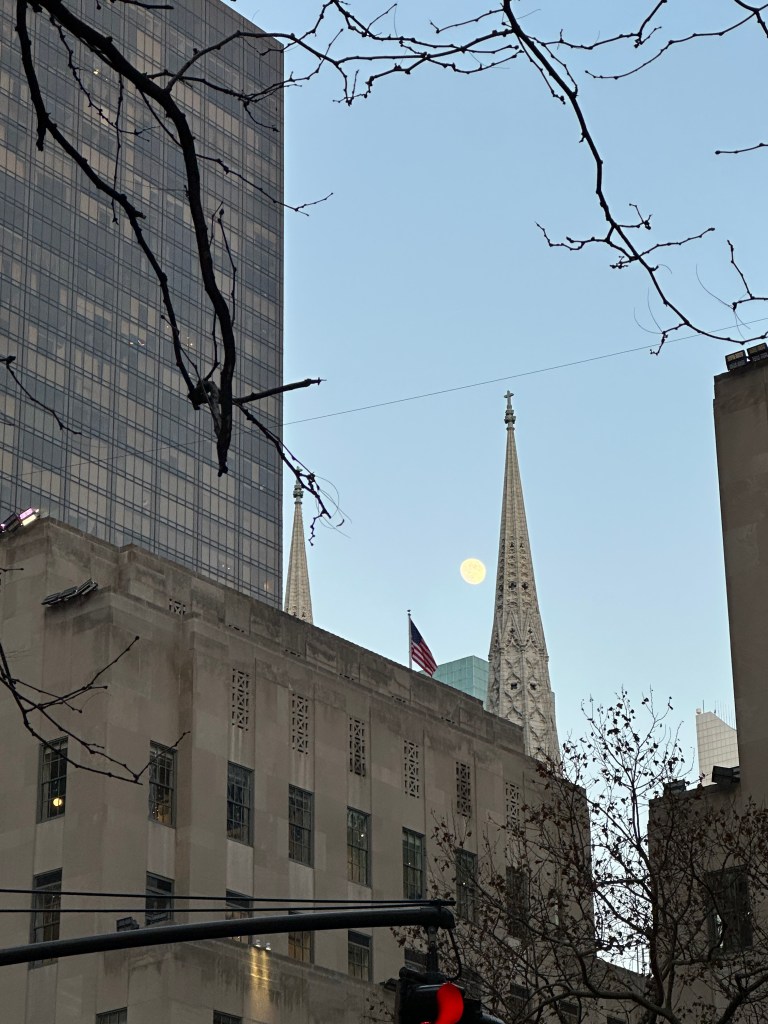
Here is the moon as seen in the sky behind St. Patrick’s Cathedral.